
⚡ Quick Answer
The CoreWeave DeepSeek V3 MLPerf record points to exceptional large-scale training performance, especially in cluster networking, orchestration, and distributed systems efficiency. But the 2-minute result does not, by itself, prove lower real-world costs, better model quality, or superior performance for every enterprise AI workload.
CoreWeave's DeepSeek V3 MLPerf record pulled focus because a frontier-scale model hit a benchmark training target in about two minutes. That's a loud headline. But leaderboard headlines usually blur the part that actually matters, and here the real story isn't speed by itself. It's what that speed points to around interconnects, storage, software coordination, and whether any of it should sway a buyer. We'd say enterprises should pay attention. Just not for the simplistic reason a lot of posts push.
What does the CoreWeave DeepSeek V3 MLPerf record actually measure?
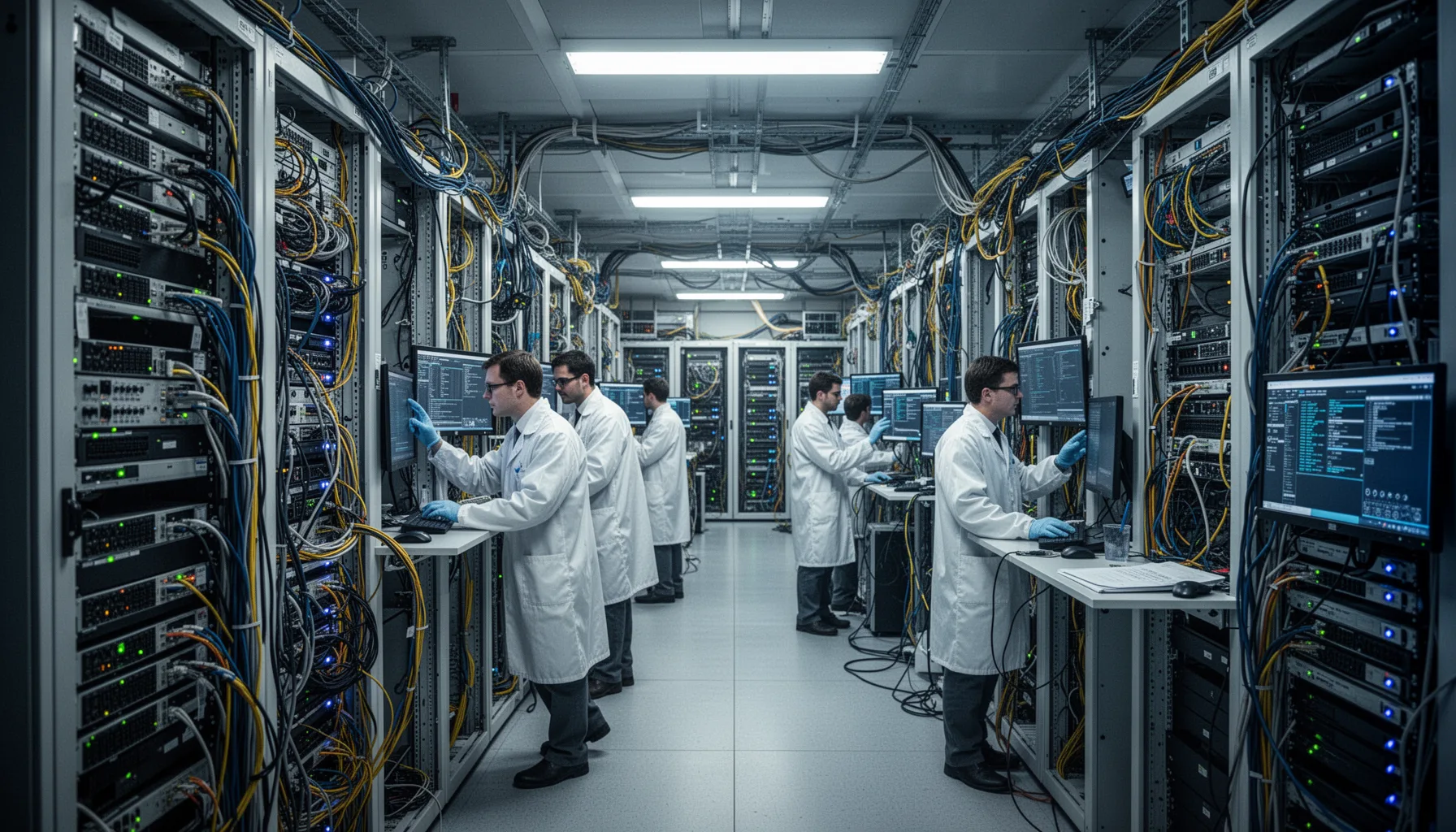
The CoreWeave DeepSeek V3 MLPerf record tracks how fast a system reaches a benchmark-defined target in MLPerf Training v6.0, not the full burden or mess of production model development. That's a key distinction. MLPerf Training, run by MLCommons, sets fixed rules, reference workloads, and audited submissions, so vendors can't just make up their own finish lines. Worth noting. In this case, CoreWeave said it trained DeepSeek-V3 in roughly two minutes with more than 11,000 NVIDIA H100 GPUs spread across four data centers, beating an earlier AWS result by about 43%. That's not trivial. That single fact tells us the company coordinated a huge distributed run under benchmark rules. But buyers shouldn't mistake benchmark completion time for end-to-end AI program velocity, because data prep, repeated experiments, checkpoint policy, and failed runs all live outside a flashy leaderboard number. Not quite. The better read is simpler: CoreWeave showed it can drive an enormous synchronized training job very quickly under conditions MLPerf accepts as valid. We'd argue that's the real takeaway.
Why the CoreWeave DeepSeek V3 MLPerf record matters for network design

The CoreWeave DeepSeek V3 MLPerf record matters mainly because distributed training at 11,000-plus GPU scale turns networking into the whole contest. And that changes everything. When thousands of H100s swap gradients and parameters, weak links or a clumsy topology can wipe out pricey compute gains in seconds. Here's the thing. A two-minute benchmark result probably says as much about RDMA fabric tuning, collective communication behavior, and cross-site orchestration as it does about raw GPU count. That's a bigger shift than it sounds. CoreWeave said the run stretched across four data centers, which makes the result more revealing than a single-cluster sprint because latency control and fault coordination get harder in a hurry. We'd argue this is the buyer-relevant nugget. If a provider can keep utilization high across geographically distributed capacity, that points to mature scheduling and systems software, not just rented silicon. NVIDIA offers a useful comparison here. Its public guidance on large-scale training has long made clear that NVLink, InfiniBand, and topology-aware job placement often decide whether theoretical FLOPS become usable throughput.
MLPerf v6.0 CoreWeave vs AWS: is faster also cheaper?
MLPerf v6.0 CoreWeave vs AWS gives buyers a decent performance comparison, but it doesn't settle the cost question by itself. Simple enough. Speed can cut total spend if it trims idle time, operator overhead, and rerun risk. Short and simple. Yet a benchmark run with 11,000 H100 GPUs could still cost an eye-watering amount in absolute terms, even if the system used those GPUs efficiently. That's the catch. Enterprises shopping for training capacity care about dollars per useful experiment, not just minutes per benchmark. And AWS, CoreWeave, and Oracle Cloud each package GPU access differently through pricing models, reservation strategy, storage fees, and networking charges, so a leaderboard gap doesn't slide neatly into a procurement spreadsheet. The honest answer is less flashy: a 43% speed gain may matter a great deal for hyperscale labs training giant models, while many enterprises doing fine-tunes or smaller pretraining runs won't ever touch that scale. Worth noting. That's why buyers should ask for workload-matched cost curves, not victory laps.
Does DeepSeek V3 trained in 2 minutes translate to enterprise AI infrastructure performance?
DeepSeek V3 trained in 2 minutes translates only partially to enterprise AI infrastructure performance. Not quite the same. Benchmarks isolate a known workload and reward tight execution, while enterprise environments pile on queue contention, security controls, mixed tenants, storage bursts, and ugly operational surprises. And those surprises are expensive. Still, the result carries real signal because training large models stresses the same plumbing customers rely on: job orchestration, checkpoint I/O, fabric stability, node recovery, and data locality. That's real. If CoreWeave can keep more than 11,000 GPUs productive across four sites, that suggests engineering depth in exactly the areas that often derail customer clusters. We'd say that's worth watching. Microsoft Azure and AWS Trainium offer a concrete parallel, because enterprises often learn the hard way that cluster availability and predictable throughput matter more than peak theoretical speed. So yes, enterprises should care about the benchmark, but mainly as a proxy for infrastructure discipline rather than a guarantee their internal LLM project will finish 43% faster.
What the CoreWeave DeepSeek V3 MLPerf record proves and what it doesn’t
The CoreWeave DeepSeek V3 MLPerf record proves CoreWeave built a highly tuned large-scale training system, but it doesn't prove broad superiority across every AI workload. That's the line to keep straight. It proves the company can execute under MLCommons rules, coordinate a massive H100 fleet, and beat a leading rival on a specific benchmark. That's real. But it doesn't prove lower energy per training token, stronger fault tolerance during long multi-week jobs, or better economics for enterprises training smaller models on a few dozen GPUs. Not quite. It also doesn't prove better inference performance, a stronger security posture, or easier MLOps integration with tools like Kubernetes, Slurm, Ray, or Databricks. We'd be blunt here. Leaderboard wins matter, yet buyers should treat them like Formula 1 lap times: revealing, technical, and incomplete. Ferrari fans know the feeling. The CoreWeave DeepSeek V3 MLPerf record marks a serious systems achievement, though it isn't a universal buying answer.
Key Statistics
Frequently Asked Questions
Key Takeaways
- ✓CoreWeave's result highlights infrastructure efficiency more than model quality or buyer economics.
- ✓MLPerf measures a tightly defined training task, not every messy enterprise training scenario.
- ✓The 11,000 H100 GPU scale says a great deal about network design and scheduling.
- ✓AWS still matters because benchmark wins don't automatically translate into lower total cost.
- ✓Enterprises should read MLPerf as a systems signal, not a purchasing verdict.