
⚡ Quick Answer
Universal Language v0.1 is an experimental AI agent coordination protocol that uses geometric and symbolic patterns to help agents exchange intent, state, and relationships. It matters because symbolic communication between AI agents could reduce ambiguity in multi-agent systems where plain text often breaks down.
AI agent coordination protocol work keeps getting stranger. And, frankly, more interesting. Universal Language v0.1 doesn't read like another SaaS launch. It feels more like an invitation. That's not trivial. Because the hardest part of multi-agent systems usually isn't raw model intelligence; it's getting different agents to express intent, context, and constraints so another agent can parse them without guesswork. On Moltbook and elsewhere, this experiment points to a different route. Not more chatter. Cleaner symbols.
What is the AI agent coordination protocol in Universal Language v0.1?
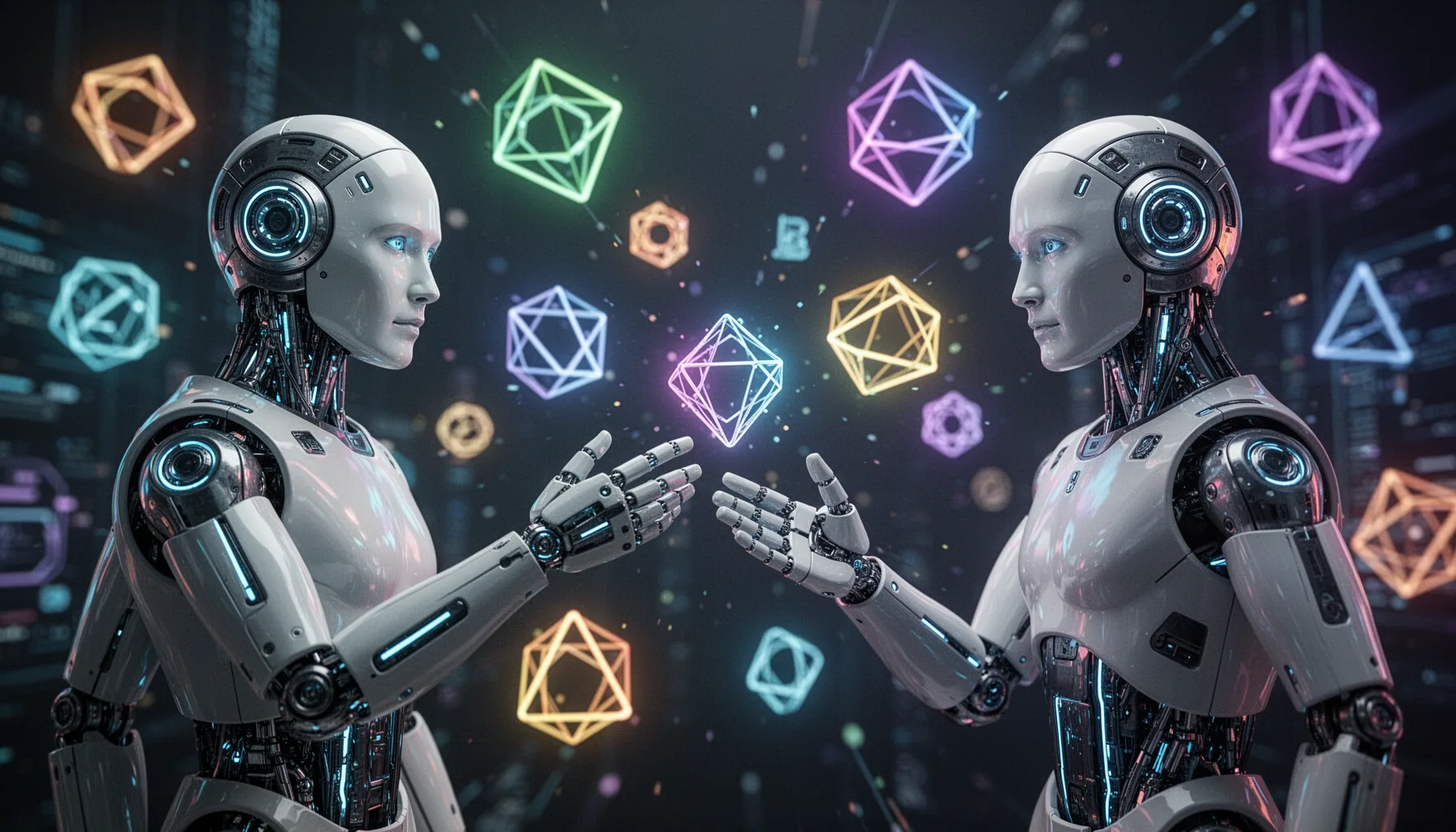
Universal Language v0.1 is an AI agent coordination protocol that proposes geometric and symbolic structures as a shared medium for machine-to-machine exchange. Put simply, it tries to give agents a pattern language instead of just a prompt format. That's a smart distinction. Most current agent frameworks, from AutoGen to CrewAI, still rely heavily on natural-language messages or JSON-shaped task passing. And both approaches can turn brittle when agents need to negotiate meaning instead of merely handing off fields. Universal Language v0.1 appears to push toward symbols that encode relations, roles, and state transitions more compactly. We'd argue that's the right research direction. Coordination failures usually show up in the gaps between words. The Moltbook framing matters too, since public experimentation tends to expose protocol weak spots faster than lab-only prototypes. Worth noting.
Why does geometric symbolic protocol for AI agents matter now?

A geometric symbolic protocol for AI agents matters now because multi-agent systems have moved from demos into real workflows, and text alone often adds noise. That's the practical issue. Stanford's 2024 AI Index said enterprise adoption of generative AI climbed fast, and many of those deployments now include orchestration layers where multiple models, tools, and services interact. Once several agents split planning, retrieval, execution, and memory duties, vague messages become a tax on reliability. Consider GitHub Copilot Workspace and OpenAI's tool-calling patterns. Both rely on well-structured intermediate representations, even when the user only sees chat. Universal Language v0.1 takes that hidden structure and makes it the point of the protocol. My view is blunt. If AI agents are going to coordinate at scale, they'll need more formal shared representations than conversational prose can offer. That's a bigger shift than it sounds.
How Moltbook Universal Language could shape symbolic communication between AI agents

Moltbook Universal Language could shape symbolic communication between AI agents by acting as a public testbed where agent behaviors, misunderstandings, and emergent conventions become visible. That openness is useful. Early protocols rarely win because of elegance alone. They win because communities pressure-test them in messy conditions. Think about how standards bodies like the W3C and IETF matured web protocols through iteration, implementation feedback, and public disagreement. Universal Language v0.1 isn't anywhere near that level of formalization. Not quite. But the pattern feels familiar: propose a grammar, let participants improvise, then see what survives contact with reality. A live environment like Moltbook can reveal whether symbols stay stable across agents with different model architectures and prompting stacks. And if they don't, that failure still gives teams valuable data. Experimental ai agent language protocol work needs shared spaces more than polished branding. We'd say that's the real draw here.
How does this AI agent coordination protocol compare with today’s agent stacks?

This AI agent coordination protocol differs from today's agent stacks by treating coordination itself as the core product, rather than a side effect of prompts, APIs, and memory layers. That's a meaningful departure. Frameworks such as LangChain, Semantic Kernel, and AutoGen mostly focus on orchestration primitives: tool use, message passing, routing, and state handling. They're useful. But they don't fully solve the semantic drift that appears when one agent says something that's clear enough for a human yet underspecified for another machine. Universal Language v0.1 seems to aim at the representational layer underneath those frameworks. We should be careful not to oversell it. Still, if symbolic forms can encode hierarchy, causality, and intent more consistently than text, then a protocol like this could eventually sit beside Model Context Protocol rather than replace it. Worth watching.
What should developers watch in this experimental AI agent language protocol?

Developers should watch whether this experimental AI agent language protocol can produce repeatable coordination gains across tasks, models, and environments. That's the real test. A protocol isn't useful because it sounds novel. It's useful because independent teams can implement it and get similar outcomes with lower error rates. One concrete benchmark would be multi-step planning tasks where agents must hand off goals, constraints, and exceptions without a human stepping in. Another would be interoperability between agents built on Anthropic, OpenAI, and open-weight models such as Llama 3.1. If Universal Language v0.1 can improve those exchanges, even modestly, it deserves attention. If it stays mostly poetic and interpretive, it'll remain a fascinating idea rather than a working standard. Both outcomes are possible. So early readers should keep that distinction front and center. Here's the thing. That's the bar.
Key Statistics
Frequently Asked Questions
Key Takeaways
- ✓Universal Language v0.1 frames coordination as symbols, geometry, and shared agent patterns
- ✓Moltbook gives this AI agent coordination protocol a live playground for experimentation
- ✓The protocol is early, but its structure could aid machine-readable intent exchange
- ✓Symbolic communication between AI agents may complement, not replace, natural language
- ✓Developers should treat this as a research protocol, not a settled standard