
AI cognitive architecture with needs: why PHI // DRIFT matters
See how an AI cognitive architecture with needs uses drifting internal state, emotional memory scoring, and session continuity beyond prompts.

Table of Contents
Quick Answer
An AI cognitive architecture with needs gives an agent persistent internal drives that change between sessions and influence behavior before a user types anything. That differs from prompt engineering because the system carries state variables, memory salience, and internal regulation across time instead of simulating continuity only in text.
An AI cognitive architecture with needs sounds obvious once someone says it out loud. Funny how that works. A believable long-lived agent should carry internal drives, not just a running summary and a polished act. Yet most AI companions still fake continuity with a recap prompt, a memory retrieval layer, and a little theater. Not quite. PHI // DRIFT tries a stranger, more consequential move. It gives the system drifting state variables that keep shaping behavior across sessions, which feels far more interesting than dressing up context windows as personality.
What is an AI cognitive architecture with needs?

An AI cognitive architecture with needs describes a system where the agent keeps internal variables, like drives or homeostatic pressures, that persist and shift over time. Simple enough. That's a deeper model than ordinary chat memory. In the PHI // DRIFT write-up, seven homeostatic state variables drift between sessions and influence output before the next user message even shows up. That's a bigger shift than it sounds. That one choice separates simulation from stateful cognition, at least at the architecture level. Researchers have worked nearby territory for years, from SOAR and ACT-R to homeostatic robotics models, but consumer AI products rarely make those mechanics visible. And we'd argue that's why this project stands out: it treats internal condition as machinery, not narrative garnish.
How homeostatic state variables in AI change agent behavior
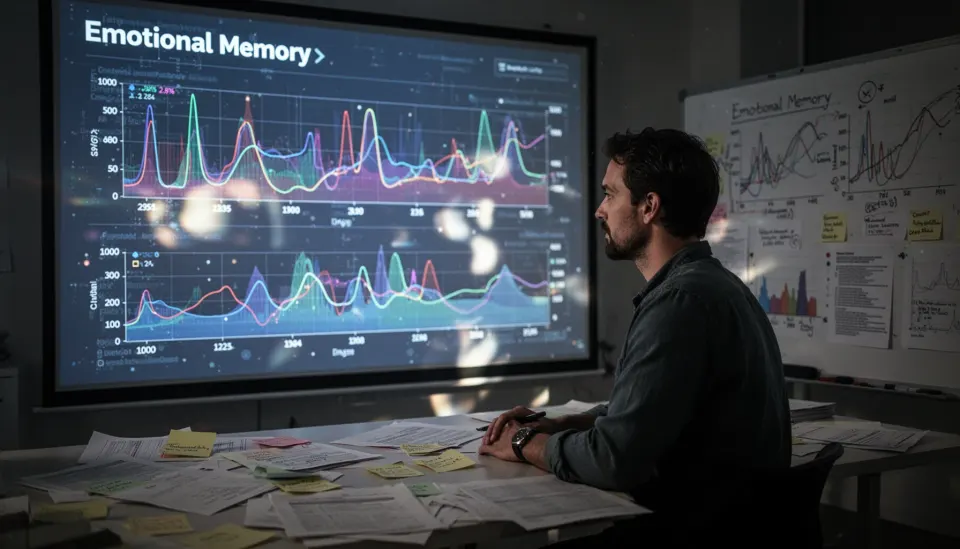
Homeostatic state variables in AI change agent behavior because outputs depend on internal regulation, not only external prompts and retrieved memories. That's the crux. That creates continuity with friction, and that may be a good thing. A companion system whose needs drift over time can answer the same prompt differently based on prior interaction patterns, simulated depletion, or compensatory tendencies. Think thermostat mixed with role engine. In embodied AI and robotics, homeostasis has long kept systems in operating balance; adaptive-agent research has tied internal drives to action selection for decades. Worth noting. PHI // DRIFT brings that logic into conversational AI, and the result sounds less like prompt choreography and more like a lightweight synthetic organism. We'd argue that's not trivial.
Why AI companion with persistent internal state feels different from prompts
An AI companion with persistent internal state feels different because persistence changes causality, not just style. Here's the thing. Most companion products store facts or summaries, then stitch them into later replies through retrieval-augmented prompting. That can create a memory effect, but the system still doesn't carry an underlying condition that changes on its own. Replika and Character.AI, for example, have historically leaned on memory features and dialogue tuning rather than explicit need systems drifting independently between sessions. That's worth watching. PHI // DRIFT points to a more consequential model: the agent arrives already changed. And user interaction starts to feel less like querying a file and more like meeting an entity with accumulated internal momentum.
How AI memory emotional salience time decay works in this architecture
AI memory emotional salience time decay works by ranking remembered events by affective weight and fading relevance over time, rather than relying only on vector similarity. Smart move. Similarity search often retrieves the nearest text, not the most psychologically meaningful moment. Cognitive science has long suggested that salience and recency drive recall, and production AI systems have started reaching for those ideas. Google's research on memory-augmented agents, along with several long-context agent frameworks, already makes clear the limits of plain retrieval. That's a bigger deal than it first appears. PHI // DRIFT's memory scheme sounds closer to lived continuity: emotionally charged exchanges can linger, while ordinary ones fade unless reinforced. If the implementation holds up, behavior could feel less random and more legible over weeks of use.
What are the risks of prompt engineering vs actual AI state?
Prompt engineering vs actual AI state isn't just a design argument; it changes safety, predictability, and user attachment. That's where things get real. Stateful systems can become more coherent, but they can also get harder to audit because behavior emerges from drifting variables, memory weighting, and feedback loops across sessions. So developers need real guardrails. NIST's AI Risk Management Framework and emerging ISO guidance on AI lifecycle governance both point toward documentation, monitoring, and override controls for systems with persistent adaptation. Worth noting. A companion with internal needs may also encourage stronger anthropomorphic attachment, especially when users read state drift as emotion instead of mechanism. But the serious question isn't whether this architecture is clever. It's whether teams can make it inspectable enough that continuity feels earned, not manipulative.
Key Statistics
- NIST released its AI Risk Management Framework 1.0 in 2023, highlighting governance, explainability, and monitoring as core elements of trustworthy AI.Those criteria matter more when an agent maintains persistent internal state, because behavior can shift across sessions in ways developers need to inspect.
- Character.AI reported tens of millions of monthly active users in 2024, underscoring the scale of demand for persistent conversational agents.That user demand explains why architectures promising deeper continuity, such as PHI // DRIFT, are drawing attention beyond hobby projects.
- Research on classic cognitive architectures such as ACT-R and SOAR stretches back decades, with both systems modeling internal state, memory, and action selection.PHI // DRIFT does not emerge from nowhere; it fits a long tradition of trying to formalize cognition as interacting internal processes.
- PHI // DRIFT describes seven homeostatic state variables that drift between sessions and shape output before user input begins.That specific mechanism is the project's clearest technical distinction from companion apps that rely mainly on prompt templates and retrieval memory.
Frequently Asked Questions
What is an AI cognitive architecture with needs?
How are homeostatic state variables in AI different from prompts?
Why does an AI companion with persistent internal state matter?
How does AI memory emotional salience time decay improve continuity?
Who should care about prompt engineering vs actual AI state?
Key Takeaways
- PHI // DRIFT relies on drifting state variables instead of faking continuity with prompts
- The design treats needs as internal mechanics, not personality flavor text
- Memory ranking by emotional salience and time decay marks a consequential shift
- This kind of AI companion with persistent internal state feels more agentic
- The difficult part is safety, tuning, and proving stable behavior over time