
AI Productivity Survey: Why Managers Face More Oversight
This AI productivity survey finds managers spend more time reviewing work and expect to oversee more AI agents. See what leaders reported.
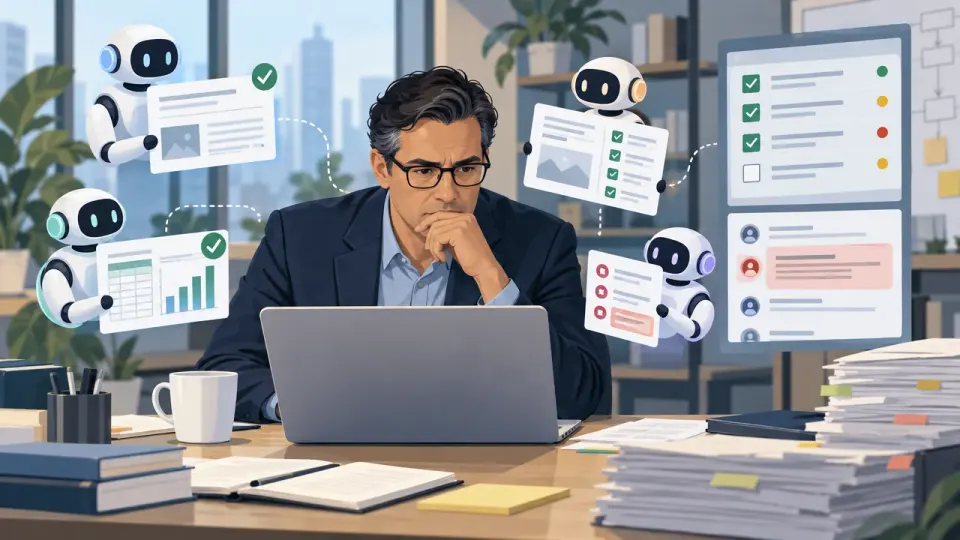
Table of Contents
Quick Answer
The AI productivity survey found that AI-assisted work is adding review and oversight responsibilities for managers, even as it helps produce work. In the Nielsen survey of 1,700 directors and senior managers across seven countries, nearly half said they spend longer reviewing and guiding team output, and 58% expect to oversee more AI agents than human employees within a year.
Commissioned by Monday.com, the survey highlights a tension in workplace AI adoption: tools can help produce work, but managers still need to judge its quality and determine who is responsible for it.
What the Survey Found About AI and Manager Productivity
More than half of surveyed leaders said it has become harder to evaluate employees’ contributions as AI-assisted work becomes more polished. When the output looks finished, it can be more difficult to see what an employee contributed, how they made decisions or how much work the task involved.
The review process can also take more time. Nearly half of managers said they spend longer reviewing and guiding their teams’ output. That finding points to a gap between faster generation and faster completion: AI can help create a draft or deliverable, but managers may still need to check it, give direction and ensure it meets expectations.
This does not mean AI offers no productivity benefits. Rather, the survey indicates that those benefits do not automatically reduce management work. Review and guidance remain part of the process, even when employees use AI to produce work more quickly.
Why AI-Assisted Work Is Harder to Review and Evaluate
Employee assessments are changing alongside the work itself. Seventy-eight percent of respondents said they have changed how they evaluate employees. The survey points to greater emphasis on skills such as prompting, delegating tasks to AI and experimenting with AI tools.
These changes raise practical questions for performance evaluation. Managers may need to consider not only the final result, but how employees used AI, whether they checked its output and how they applied their own judgment. A polished deliverable alone may reveal less about an employee’s individual contribution than it once did.
Managers are also using AI in their own work. Forty-six percent said they use AI to help inform management decisions, while 39% use it to draft performance reviews. These uses may assist with decision-making and writing, but they also make clear that AI is entering both sides of the evaluation process: the work being assessed and the tools managers use to assess it.
Managers Expect to Oversee More AI Agents - and Remain Accountable
The survey also points to growing expectations around AI agents, which can carry out tasks with some degree of autonomy. Fifty-eight percent of managers expect to oversee more AI agents than human employees within a year. At the same time, 46% worry about losing control over agents’ actions.
That combination creates an oversight challenge. Managers may need to set boundaries for what agents can do, monitor their work and decide when a person must step in. The survey’s findings do not suggest that human accountability is disappearing as AI takes on tasks. Instead, they show managers anticipating more responsibility for supervising systems whose actions can be harder to track or direct.
Overall, the survey captures the gap between AI’s promise of faster work and the day-to-day demands of managing it. For organizations, the challenge is not only adopting AI tools, but also establishing clear review standards, defining accountability and preparing managers to supervise AI agents. Practical guidance on evaluating employee performance, reviewing AI-generated work and governing workplace agents can help teams address those responsibilities as adoption grows.
Step-by-Step Guide
Set review standards for AI-assisted work
Define what managers should check in AI-assisted deliverables, including quality, accuracy, employee judgment and whether the work meets team expectations.
Evaluate contributions beyond the final output
Ask employees to explain their decisions, how they used AI and how they checked or revised its output so polished work does not obscure individual contributions.
Define boundaries for AI agents
Specify which tasks agents may perform, what actions require approval and when a manager or employee must intervene.
Prepare managers for ongoing oversight
Give managers practical guidance for reviewing AI-generated work, assessing AI-related skills and maintaining accountability for agent actions.
Key Statistics
- The survey included 1,700 directors and senior managers across seven countries.Nielsen conducted the survey, which was commissioned by Monday.com, according to the article.
- 78% of respondents said they have changed how they evaluate employees.The article attributes this finding to the Nielsen survey and describes increased attention to skills such as prompting, delegating tasks to AI and experimenting with AI tools.
- 58% of managers expect to oversee more AI agents than human employees within a year.This expectation was reported by respondents to the Nielsen survey commissioned by Monday.com.
- 46% of managers worry about losing control over AI agents' actions.The article reports this concern as part of the same survey's findings on workplace AI-agent oversight.
Frequently Asked Questions
What did the AI productivity survey find about managers?
Why is AI-assisted work harder for managers to evaluate?
How many managers expect to oversee more AI agents than employees?
How are managers using AI in their own work?
Key Takeaways
- More than half of surveyed leaders said polished AI-assisted work makes employee contributions harder to evaluate.
- Nearly half of managers said they spend longer reviewing and guiding their teams' output.
- Seventy-eight percent of respondents said they have changed how they evaluate employees, including considering AI-related skills.
- Forty-six percent of managers use AI to help inform management decisions, and 39% use it to draft performance reviews.
- Fifty-eight percent expect to oversee more AI agents than human employees within a year, while 46% worry about losing control over agents' actions.