
Domain-Specific AI Training Data: Build Better Datasets
Learn how to build domain-specific AI training data with practical quality, coverage, privacy, and evaluation checks before you train.
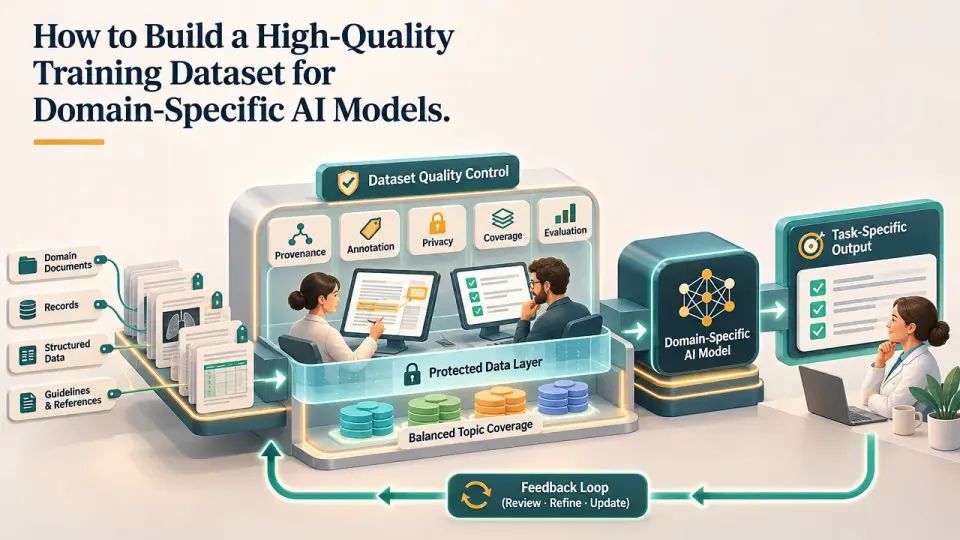
Table of Contents
Quick Answer
Build domain-specific AI training data by defining the model's tasks and boundaries, selecting relevant data with verified provenance and permissions, and applying documented quality, coverage, privacy, and annotation standards. Keep evaluation data separate, test for task-relevant errors, and use results to improve the dataset in tracked cycles.
Tether AI Research’s STEM-focused Genesis III is one reported example of a domain-oriented approach. A sponsored WIRED article described its focus on science, technology, engineering, and mathematics and reported benchmark results. Those results are specific to the reported system and context, not a general performance guarantee. The broader lesson is to define what a model must do, then build and assess data for that purpose.
1. Define the task and the dataset’s boundaries
Start by writing down what the model is expected to do before gathering examples. Specify:
- Users: Who will rely on the model, and what expertise can they be expected to have?
- Tasks and outputs: Will it answer questions, classify records, extract fields, draft text, or support another workflow?
- Domain limits: What subjects, settings, languages, and input types are in scope? What should the model decline or refer elsewhere?
- Failure costs: What could happen if the model is wrong, incomplete, or overconfident?
For example, a model that summarizes equipment maintenance records has a different data need from one that recommends repairs. The second may require stronger expert review and explicit coverage of situations where the safe answer is to escalate to a qualified person.
These boundaries guide decisions throughout dataset curation. They also help prevent a common mismatch: collecting data that is easy to access rather than data that reflects the intended task.
2. Find relevant data and verify its provenance
Inventory candidate sources and record where each dataset or example came from. For every source, check its provenance, permissions, license terms, use restrictions, and collection context. Do not assume that material available online is automatically permitted for model training or redistribution. If rights or restrictions are unclear, resolve them before inclusion.
Also assess source quality. Consider whether the material is current enough for the task, whether it represents real use conditions, and whether its original purpose affects how it should be interpreted. A collection of textbook explanations, for instance, may not reflect the shorthand, incomplete information, or unusual cases found in real user requests.
Favor relevant, accurate examples over volume for its own sake. Where specialized knowledge is important, expert-vetted material can help identify subtle errors and distinguish an acceptable answer from a plausible-sounding one. Experts can review every example, or focus on high-risk, ambiguous, and technically demanding portions of the dataset. Record what review occurred rather than describing the entire collection as expert-vetted if only a subset received that treatment.
3. Set quality, annotation, and coverage standards
Write inclusion and exclusion rules before scaling collection. Define the expected format, minimum information needed, acceptable sources, and reasons to reject an example. Remove duplicates and near-duplicates where they could cause repeated cases to dominate training or leak into evaluation. Review for factual accuracy, relevance, formatting problems, and contradictions.
If examples need labels, create annotation guidance with definitions and edge cases. For a medical classification task, for example, instructions should clarify how annotators handle incomplete records and when a label should be marked uncertain rather than inferred. Have qualified reviewers resolve disagreements, and keep a record of the instructions, annotator expertise, disagreement patterns, and resolution process. Disagreement can reveal unclear labels or genuine ambiguity in the domain, not just careless annotation.
Assess coverage systematically. Check whether the dataset includes important subtopics, user groups, formats, and levels of difficulty. Depending on the task, useful dimensions might include common and rare cases, different terminology, short and long inputs, or examples with missing context. For language data, document the populations and language varieties represented, how data was collected, and known limitations. Preprocessing can also change the balance or character of a dataset, so record consequential filtering and transformation decisions.
Do not imply that a dataset is comprehensive if it is not. Make gaps visible, prioritize those that matter for intended users, and explain which cases the model has not been designed to handle.
4. Protect the data and document how it was built
Review data for personal, confidential, or otherwise sensitive information. Decide whether it should be excluded, redacted, transformed, or handled under additional access controls. Build privacy and security checks into data preparation and ongoing governance, rather than treating them as final cleanup steps. The right approach depends on the data, applicable obligations, and the risks of exposure or misuse.
Create dataset documentation, such as a dataset card, that explains the collection’s motivation, composition, collection and processing methods, intended uses, and limitations. Include relevant details about sourcing, licensing, annotation, known gaps, privacy measures, and quality checks. Documentation helps model developers and downstream users judge whether a dataset is appropriate for their use - and helps prevent a narrow collection from being mistaken for a universal resource.
5. Evaluate the dataset and improve it in cycles
Keep evaluation examples separate from training data. If evaluation cases appear in training, performance measurements can overstate how well the model handles new examples. Create a held-out set that reflects the real task, including important subdomains and difficult cases, while protecting sensitive information and respecting data permissions.
Choose measures that match the consequences of errors. Depending on the task, assess correctness, completeness, coverage, consistency, and whether the model knows when to abstain or escalate. In high-impact settings, report serious failure types separately instead of hiding them inside an overall score. Document who or what produced the evaluation, the conditions under which it was run, and its limitations.
Use results to identify weak areas, then improve the data or the task definition. If a model struggles with a specific subtopic, add suitable examples only after checking their quality and permissions. Retrain and test again. Track dataset versions, changes, and review decisions so results are reproducible and teams can understand what changed between model iterations.
Use this dataset-readiness checklist before training
- Task fit: Are intended users, outputs, boundaries, and failure costs clear?
- Provenance: Are sources, permissions, licenses, and restrictions documented?
- Quality: Are inclusion rules, deduplication, accuracy checks, and review practices defined?
- Representation: Have important topics, users, formats, and difficulty levels been assessed? Are gaps recorded?
- Annotation: Are instructions clear, and are reviewer expertise and disagreements documented?
- Privacy and security: Have sensitive information and access risks been addressed?
- Evaluation: Is there a separate, domain-relevant test set with measures suited to the task?
- Documentation and versioning: Can another team understand the dataset’s composition, uses, limitations, and changes?
Use the checklist to identify gaps before training. If provenance, coverage, or evaluation is unclear, address those issues before scaling the dataset. More data is useful only when it is suitable for the task and the team can explain where it came from, what it represents, and how well it supports the intended model.
Step-by-Step Guide
Define the task and boundaries
Specify who will use the model, what outputs it should produce, which subjects and input types are in scope, when it should decline or escalate, and what errors could cost.
Verify data sources and permissions
Inventory candidate sources and record their provenance, licenses, restrictions, collection context, and relevance. Resolve unclear rights before including material.
Set quality and annotation standards
Write inclusion and exclusion rules, deduplicate examples, define annotation labels and edge cases, and document reviewer expertise and disagreement resolution.
Assess coverage and protect sensitive data
Check representation across important topics, users, formats, and difficulty levels. Identify privacy and security risks, apply appropriate safeguards, and document gaps and limitations.
Evaluate and improve in tracked cycles
Keep a domain-relevant test set separate from training data, measure errors that matter for the task, address weak areas, and record dataset versions and changes.
Key Statistics
- The dataset-readiness checklist covers 8 areas.Counted from the article's checklist: task fit, provenance, quality, representation, annotation, privacy and security, evaluation, and documentation and versioning.
- The article presents a 5-stage dataset-building process.The five numbered sections cover task definition, source verification, quality and coverage, data protection and documentation, and evaluation and iterative improvement. The article does not provide a general numerical benchmark for model performance.
Frequently Asked Questions
What makes training data suitable for a domain-specific AI model?
How do you check whether AI training data is legally usable?
Why should evaluation data be separate from training data?
How can teams assess coverage in an AI dataset?
Key Takeaways
- Define intended users, outputs, domain boundaries, and the consequences of model errors before collecting data.
- Verify each source's provenance, permissions, license terms, restrictions, and suitability for the intended task.
- Set inclusion, exclusion, annotation, deduplication, and expert-review standards before scaling collection.
- Document coverage gaps, privacy measures, processing decisions, and dataset limitations.
- Use a separate, representative evaluation set and track dataset versions as you improve the data.