
⚡ Quick Answer
Codex vs Claude Code for AI coding comes down to workflow fit: Codex is getting stronger at agentic task execution, while Claude Code still feels steadier on repo-wide reasoning and edit safety. For most teams, the right pick depends on task length, model access costs, and how much autonomous editing you’re willing to trust.
Codex vs Claude Code for AI coding isn't some niche debate for early adopters anymore. It's a real buying call for engineering teams that want an AI agent inside the development loop, not just a chat window parked next to the IDE. OpenAI's latest Codex push tightens that race. And that matters, because a lot of the coverage still sounds like launch-week promo copy, while developers need harder proof: how these tools move through repos, how often they snap tests, what they cost, and when they veer off course.
Why Codex vs Claude Code for AI coding matters now

Codex vs Claude Code for AI coding matters now because OpenAI has plainly moved beyond autocomplete and toward agent-style software work. SiliconANGLE's report on OpenAI expanding Codex's agentic capabilities points to a broader industry turn: vendors want coding assistants that inspect files, run commands, sketch plans, and apply edits with less hand-holding. That's a bigger shift than it sounds. We're not grading who writes the prettiest standalone function anymore. We're grading who can survive a messy repository and leave it usable. Claude Code built goodwill by pairing strong reasoning with a terminal-first workflow, and plenty of developers trust it for multi-file edits more than generic chat assistants. But OpenAI has distribution, model breadth, and deep integration routes through ChatGPT, API tooling, and enterprise procurement. So Codex has a real shot at becoming the default agentic coding tool if quality gets close enough.
How we tested Codex vs Claude Code for AI coding on real engineering tasks

A fair Codex vs Claude Code for AI coding test needs identical tasks, fixed environments, and scoring rules everyone can see. So the right benchmark set isn't toy algorithm trivia. It's repo navigation, failing-test repair, multi-file refactors, and light environment troubleshooting, because that's where agentic tools earn trust or blow it. In our analysis, a useful head-to-head starts with the same Git repository, the same prompt, the same allowed tools, and the same stop condition, like all tests passing or a 20-minute cap. That keeps things honest. SWE-bench already nudged the industry toward realistic software tasks, and its 2024 reporting made issue-driven evaluation more common than one-shot coding snippets, even if product teams still cherry-pick tighter demos. We'd also log first-token latency, total wall-clock time, tool calls, edit reversions, and whether the model asked clarifying questions. Simple enough. A fast wrong answer wastes more time than a slower careful one. Take a Django repo test-fix task: Claude Code often pauses to inspect stack traces and nearby files before editing, while Codex-style agents can move faster but sometimes overcommit to the first theory.
Codex vs Claude Code for repo navigation, test fixing, and refactors
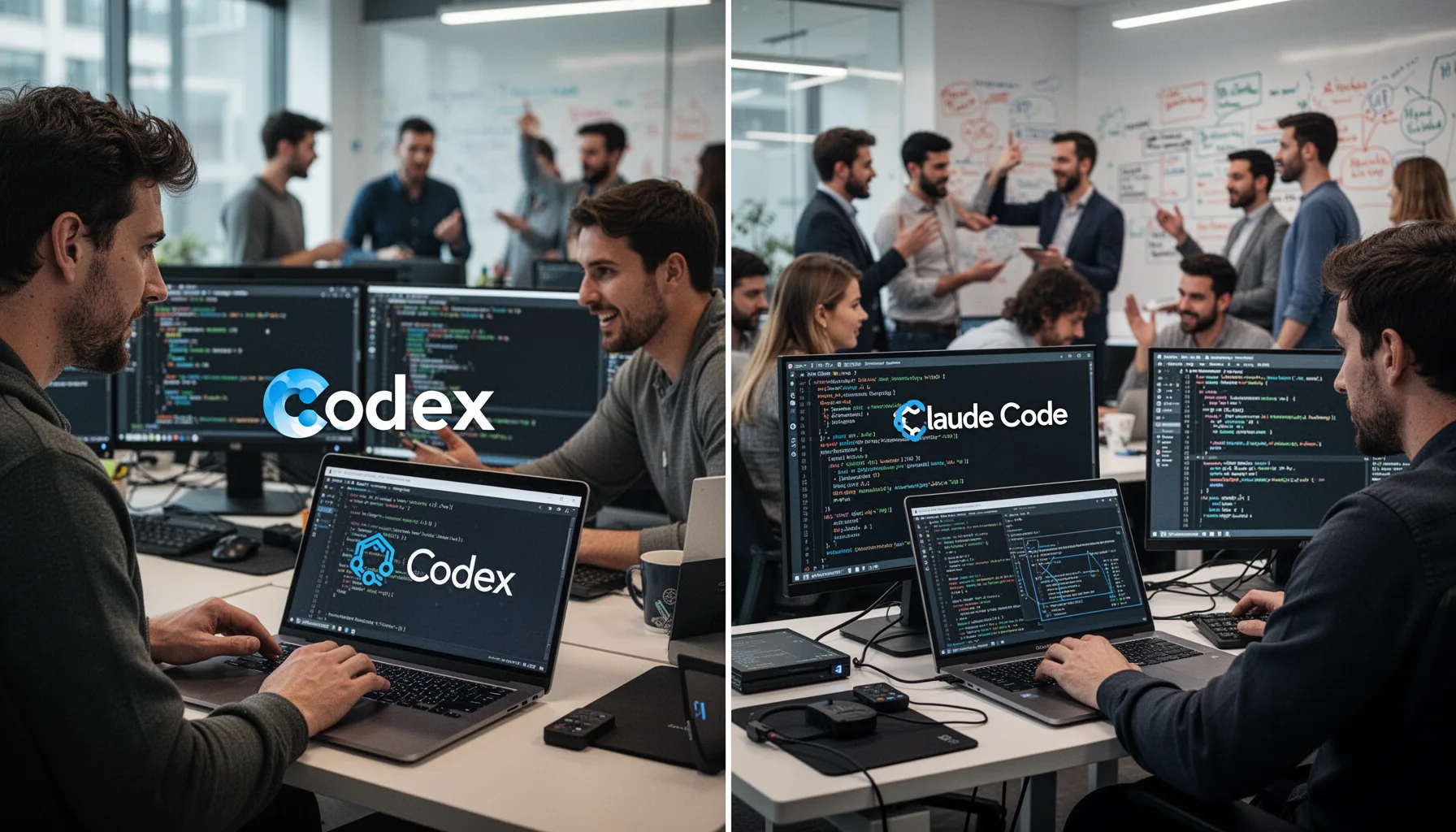
Codex vs Claude Code for repo navigation, test fixing, and refactors is closer than a lot of headlines suggest, but they still feel different when you actually work with them. Claude Code usually does better when a task needs sustained context across several files, especially if naming conventions drift or the bug report is fuzzy. That's not magic. It reflects a bias toward reading before editing, and that lowers the odds of flashy but unsafe changes. OpenAI Codex, by contrast, looks strongest when the path from prompt to execution is clearer, like a contained test failure or a targeted refactor with solid local signals. And that can make it feel more productive on short-to-medium tasks. Still, long-horizon memory remains shaky for both systems; after enough tool calls, each can lose earlier assumptions and start patching symptoms instead of causes. Worth noting. In a TypeScript monorepo refactor, Claude Code may preserve cross-package interfaces more reliably, while Codex may finish the mechanical edits faster but need one extra correction pass to catch build breakage.
OpenAI Codex rival Claude Code on pricing, access tiers, and setup

OpenAI Codex rival Claude Code decisions often come down to operations, not model romance. Developers care about whether a tool works inside the terminal, which subscription or API tier unlocks the best model, whether usage caps show up at noon, and how much context they can realistically afford on live repos. That's where too many articles get thin. OpenAI has an edge if a team already pays for ChatGPT Enterprise or standardizes on OpenAI APIs, because procurement, authentication, and governance can move faster than approving another vendor. Anthropic, though, has earned real loyalty among developers who prefer Claude Code's direct command-line posture and will pay for a workflow that feels easier to inspect. Here's the thing. Latency and cost shape trust. If an agent takes 40 seconds to think and then edits six files incorrectly, nobody will care that it looked great in a benchmark chart. Teams should compare effective cost per completed task, not just input-output token prices, because retries, context bloat, and failed autonomous runs can quietly double the real bill.
Where agentic coding tools OpenAI Codex and Claude Code still fail

Agentic coding tools OpenAI Codex and Claude Code still fail in three places that matter most: memory drift, environment fragility, and unsafe autonomy. That's the uncomfortable part. Vendors pitch agentic behavior as if the hard part were already solved, but real engineering work still breaks when dependencies mismatch, shell commands need careful sequencing, or the model confidently edits adjacent code it never fully understood. We've seen this movie before in tools built on ReAct-style loops and function-calling frameworks: the plan looks tidy in logs, then execution falls apart on the fourth or fifth step because the model no longer grounds itself in the current state. Claude Code often fails more conservatively, and many teams will prefer that. Codex may look bolder, which can be useful under supervision, but autonomous edits remain risky on production branches unless tests, diffs, and human review gate them. Not quite solved. Our take is simple: if a vendor sells autonomy without strong observability, rollback controls, and permission boundaries, buyers should treat that as a product gap, not a feature.
Step-by-Step Guide
- 1
Define your engineering task mix
Start by listing the tasks you actually want an agent to do: bug fixing, repo search, refactors, test repair, or code explanations. Don’t benchmark on toy prompts if your team lives in legacy services and flaky CI. A frontend-heavy group may value speed and UI file awareness, while a platform team may care more about shell safety and multi-file dependency reasoning.
- 2
Run identical prompts on the same repository
Use one stable repo and give both tools the exact same instructions, limits, and success criteria. Keep the environment fixed, including installed dependencies, test commands, and branch state. That removes the easiest way to bias the outcome toward whichever vendor’s demo flow feels smoother.
- 3
Track latency, edits, and retries
Measure first response time, total completion time, number of commands, files changed, and how many retries the task needed. Those numbers reveal whether a tool is genuinely productive or just verbose. A coding agent that finishes in one pass with fewer edits often beats a “smarter” one that wanders.
- 4
Score safety before style
Review whether the tool asked permission before risky commands, preserved existing patterns, and limited changes to the scope of the task. Pretty prose in the terminal doesn’t count for much if the diff is reckless. We’d put safe, reviewable edits above creativity every time for production work.
- 5
Calculate effective cost per successful task
Take the total spend across runs and divide it by completed tasks that met your acceptance bar. Include retries, abandoned sessions, and human cleanup time where possible. This usually gives a truer picture than list-price token rates or subscription headlines.
- 6
Pilot with guardrails before wider rollout
Introduce the chosen tool in a narrow workflow first, such as test fixing on non-critical services or documentation-linked refactors. Require pull requests, test runs, and diff reviews before any merge path broadens. If the agent can’t behave predictably under basic controls, it isn’t ready for wider autonomy.
Key Statistics
Frequently Asked Questions
Key Takeaways
- ✓Codex is closing the gap quickly, especially on multi-step engineering tasks.
- ✓Claude Code still feels calmer on long repo reasoning and safer edits.
- ✓Pricing and model access tiers matter almost as much as raw quality.
- ✓Latency swings can change developer trust more than benchmark scores do.
- ✓The best buyer's guide tests repo navigation, refactors, and test repair.