
⚡ Quick Answer
Computable reasoning vs AI agents is really a question about where systems should perform high-stakes logic: inside a probabilistic model or inside verifiable computation. The next generation of AI will probably win by using language models for interpretation and software for reasoning that must be checked, repeated, or audited.
Computable reasoning vs AI agents can sound abstract right up until a product fails in production. Then it gets real, fast. Over the last two years, we've watched teams pile tool use, retries, reflection loops, and planner agents onto language models that still make avoidable reasoning mistakes. Not quite. The awkward part is plain: if a step has to be correct, repeatable, and inspectable, you probably shouldn't let a stochastic model invent it from scratch.
Why computable reasoning vs AI agents is the real architecture debate

Computable reasoning vs AI agents makes the most sense as an architecture decision about where correctness actually lives. Many teams still frame it as “agents need to get smarter,” but the more consequential question asks whether the system should reason in natural-language tokens or convert the task into something software can verify. We'd argue the second path wins when stakes climb. A model can read a messy request, pull out variables, and sketch a plan. Then formal machinery should take over. A constraint solver, rules engine, SQL query planner, or theorem-backed checker can handle the parts that need steady outcomes. DeepMind's AlphaGeometry and Microsoft's work on tool-augmented reasoning both suggest the same thing: neural systems do better when they hand subproblems to formal machinery. That's a bigger shift than it sounds. This isn't anti-agent. It means agentic orchestration works best as a coordination layer, not a stand-in for computation.
What are the limitations of agentic AI when reasoning must be exact?
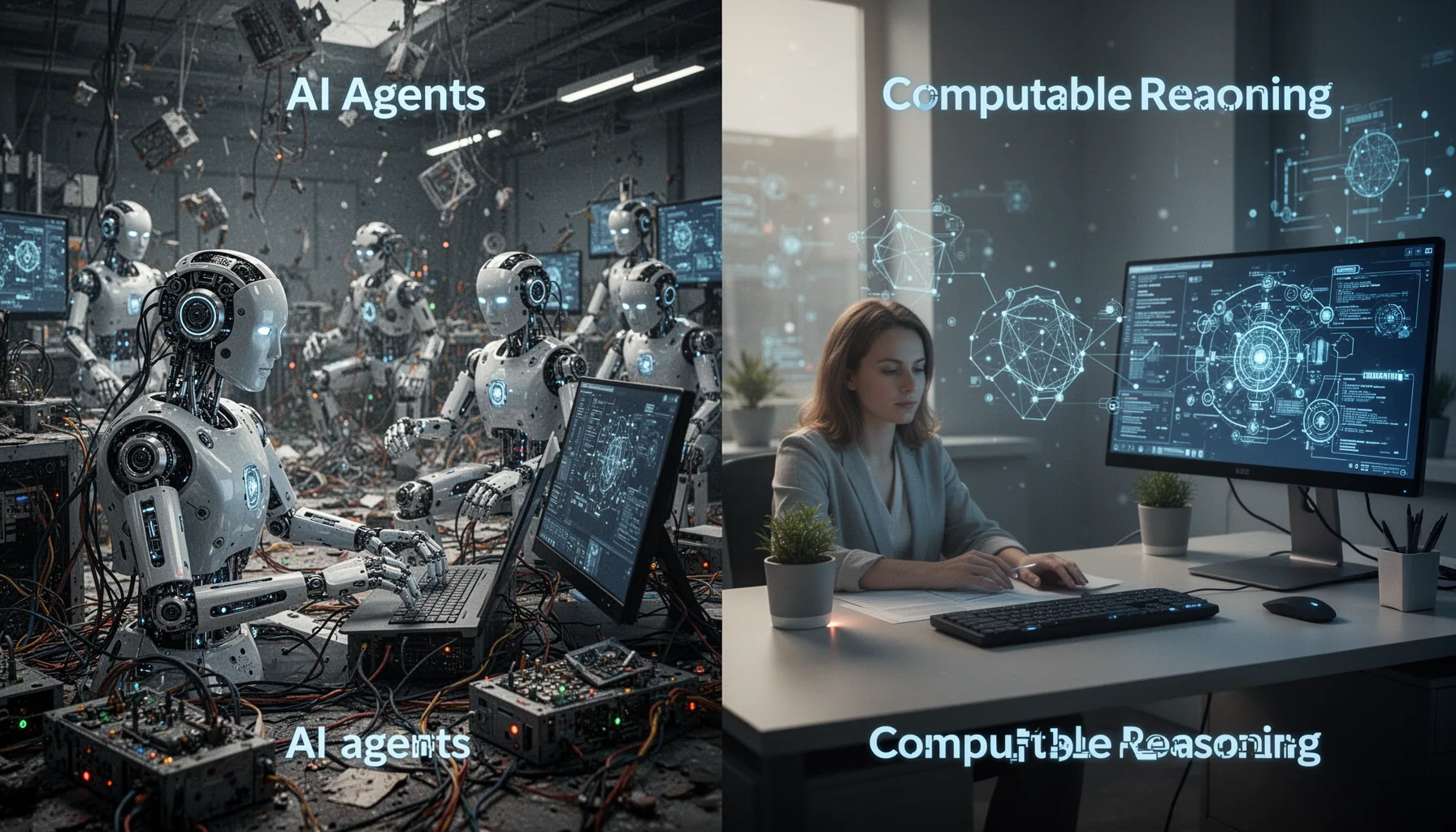
The limitations of agentic AI become easiest to spot when work demands exact arithmetic, policy compliance, scheduling constraints, or multi-step logical consistency. Agent loops can retry and critique themselves, but they still produce candidate explanations rather than proof that the answer is right. That's the crux. In software delivery, say at AWS, an agent might draft an access-control policy or a cloud cost plan, yet one wrong assumption about IAM inheritance can open a security gap that polished prose won't patch. A 2024 METR evaluation of advanced models found wide variation between plausible reasoning traces and actually correct outcomes on long-horizon tasks. Worth noting. That gap makes clear how easily confidence outruns correctness. We think too much of the market still mixes up “good at talking through logic” with “good at executing logic.” And when a system has to satisfy hard constraints, piling on more orchestration often compounds hidden errors.
How do hybrid systems solve computable reasoning vs AI agents in practice?

Hybrid systems address computable reasoning vs AI agents by separating interpretation from verification. A practical setup starts with an LLM parsing intent, extracting entities, and picking a task schema; next, the system compiles the problem into code, a query, a graph operation, a planner input, or a symbolic program. Then a deterministic engine computes the result. It returns a checked answer with provenance. That's ready for products now. Companies like Stripe, GitHub, and Datadog already rely on structured APIs, policy layers, and typed intermediate representations in nearby automation systems because free-form text alone doesn't scale well in operations. Here's the thing. In our view, the strongest pattern is simple: LLM as translator, software as adjudicator. It keeps the model where it shines, ambiguity and language and exception handling, while pushing brittle reasoning steps into machinery teams can test with fixtures, unit tests, and formal constraints.
When should teams choose reasoning infrastructure over more agents?

Teams should put money into reasoning infrastructure when correctness, auditability, or repeated reuse matters more than conversational flexibility. Good triggers include regulated workflows, pricing logic, resource allocation, compliance interpretation, code migration, and any task with explicit constraints or calculable state transitions. Put differently, if you can define the answer space, you can usually compute more of it than you think. Stanford's 2024 HELM updates, along with a growing pile of enterprise benchmark work, keep suggesting that broad model capability doesn't erase brittleness on domain-specific tasks with structured rules. That's worth watching. That should reshape roadmaps. Instead of adding one more planner, critic, and memory module, teams may see better returns from typed data contracts, rule registries, evaluation harnesses, and executable policies. So the next generation AI reasoning systems discussion gets sharper once operators ask a blunt question: what, exactly, are we asking the model to decide that code could decide better?
What architecture patterns define the next generation AI reasoning systems?

The next generation AI reasoning systems will likely look like layered stacks where language models route work but don't own every inference. Expect more typed interfaces, semantic parsers into domain languages, retrieval constrained to cited sources, policy engines like Open Policy Agent, SAT or optimization solvers for constraint-heavy tasks, and execution traces auditors can replay. That's where things seem headed. One pattern we like uses three planes: a conversational plane for user interaction, a reasoning plane for compiled task representations, and an execution plane for verified computation and system actions. IBM, Microsoft, and academic groups working on neuro-symbolic methods keep circling similar designs because they cut ambiguity at the moments that matter most. We'd argue that's the real shift. Here's the blunt take: piling more agents onto a weak reasoning core is architectural debt wearing a lab coat. Computable reasoning vs AI agents isn't about picking a tribe; it's about placing uncertainty only where uncertainty belongs.
Step-by-Step Guide
- 1
Map decision points
List every place your system currently asks a model to infer, rank, calculate, or decide. Mark which decisions need exactness, audit logs, or repeatability across runs. You'll usually find more computable steps than your prompts suggest.
- 2
Separate language from logic
Use the model to parse intent, collect missing inputs, and normalize messy text into structured fields. Then stop. Pass those fields into code, rules, or query systems that can compute outcomes deterministically.
- 3
Define typed intermediates
Create schemas for plans, entities, constraints, and tool calls instead of letting agents pass free-form prose between stages. This gives engineers test fixtures and clearer failure boundaries. It also makes debugging far less theatrical.
- 4
Add verifiers and solvers
Choose the right computation layer for the problem: a policy engine, SQL, a graph algorithm, an optimizer, or a formal checker. Keep verification outside the model whenever outcomes must be defended. That's the heart of the shift.
- 5
Instrument outcome-level evals
Measure whether the final computed answer is correct, not whether the model sounded persuasive while reaching it. Use golden datasets, counterfactual cases, and regression suites tied to business risk. Fancy chain-of-thought summaries won't save a wrong answer.
- 6
Escalate ambiguity to humans
Set clear thresholds for low-confidence parses, conflicting constraints, or incomplete source data. In those moments, ask for human review instead of spawning more autonomous loops. Restraint often beats extra agent choreography.
Key Statistics
Frequently Asked Questions
Key Takeaways
- ✓More agent loops won't fix tasks that need exact, checkable reasoning steps.
- ✓Computable reasoning vs AI agents is really a stack design question.
- ✓Rely on language models for ambiguity, then offload logic to verifiable systems.
- ✓Hybrid architectures give teams clearer failure boundaries and better debugging paths.
- ✓If a decision must be audited, don't leave it inside prompts alone.