
⚡ Quick Answer
DeepSeek could become a real DeepSeek coding agent rival Claude Code only if it ships more than a strong model. It would need reliable repo-scale editing, fast tool use, lower operating costs, and deployment options that fit Asian enterprise buyers.
DeepSeek coding agent rival Claude Code isn't some fringe theory anymore. It's turning into a real strategic question. Reports that DeepSeek is building a Harness team for coding agents matter for a simple reason: coding tools sit where model quality collides with daily habit, and habit is much harder to displace than a leaderboard slot. That's the real story. So if DeepSeek wants to challenge Anthropic, it can't just ship a chatbot that spits out snippets. It has to earn a place inside messy software teams.
Can DeepSeek coding agent rival Claude Code in real developer workflows?

Yes, but only if DeepSeek builds around workflow reliability instead of model prestige. Claude Code already rides Anthropic's strong coding reputation, long-context strengths, and a product shape that feels close to how engineers actually work in terminals and repos. That matters. In our view, developers don't switch coding agents because of one flashy benchmark; they switch when the new tool saves review time, cuts context loss, and breaks less often during multi-file edits. That's a bigger shift than it sounds. SWE-bench style evaluations have nudged the market toward agentic coding claims, while HumanEval and LiveCodeBench still shape perception, but none of them alone predicts day-to-day usefulness. Not quite. Consider Cognition's Devin, GitHub Copilot Workspace, and Cursor. Each pulled attention for agent features, yet developer trust still tracks execution consistency more than raw model branding. We'd argue DeepSeek's opening is cost-performance, especially if a DeepSeek V3 R1 coding agent roadmap pairs strong reasoning with cheaper inference. But if it can't handle repo navigation, test execution, and rollback safely, it won't truly become a DeepSeek coding agent rival Claude Code.
What does DeepSeek Harness team coding agents strategy probably look like?

The most plausible DeepSeek Harness team coding agents strategy looks like a layered product: start with code generation, then expand into terminal actions, test loops, and enterprise controls. Reports from Pandaily point to a dedicated team, and that usually suggests productization rather than pure model research inside AI labs. Worth noting. Chinese AI companies often telegraph intent through hiring language, SDK updates, GitHub activity, and enterprise pilot messaging before they launch a consumer-facing brand, and DeepSeek has already made clear it can move fast when model demand spikes. We've seen this movie before. Moonshot AI, Zhipu AI, and Baichuan all followed a similar arc, where enterprise packaging arrived months after model publicity, not years. If DeepSeek is serious, it probably starts with an IDE extension or terminal agent. Then it adds hosted orchestration, policy controls, and private deployment for regulated customers. That would match what many Chinese and Southeast Asian firms want from AI tooling. My read is simple: a Harness team name implies orchestration, evaluation, and deployment plumbing, not just a prettier chat UI, and that's exactly where coding agent products win or lose. Simple enough.
Why DeepSeek V3 R1 coding agent roadmap needs more than strong benchmarks

A DeepSeek V3 R1 coding agent roadmap needs dependable tool use, memory handling, and low-latency interactions more than another headline benchmark chart. DeepSeek V3 and R1 drew attention for strong reasoning and efficient training claims, but coding agents live or die on chained actions across files, commands, tests, and documentation. Benchmarks don't feel pain. Claude Code competitors 2026 will face a market where users expect diff previews, permission gating, shell command confirmation, and recovery from bad edits as table stakes. That's not trivial. Anthropic, OpenAI, Cursor, and GitHub have all pushed users toward that baseline, which raises the minimum viable product for any newcomer. So a coding agent that reasons well but takes too long to execute or keeps asking for re-approval will feel clumsy, even if it scores well in static evaluations. Think about a team maintaining a Java microservices stack on Alibaba Cloud or Tencent Cloud. They need local environment awareness, framework-specific fixes, and compliance-friendly logs, not merely elegant code suggestions. We'd argue DeepSeek has the model talent, probably, but it must bind that talent to product mechanics that feel boringly dependable. Here's the thing.
How DeepSeek vs Anthropic coding tools may differ on cost, latency, and deployment
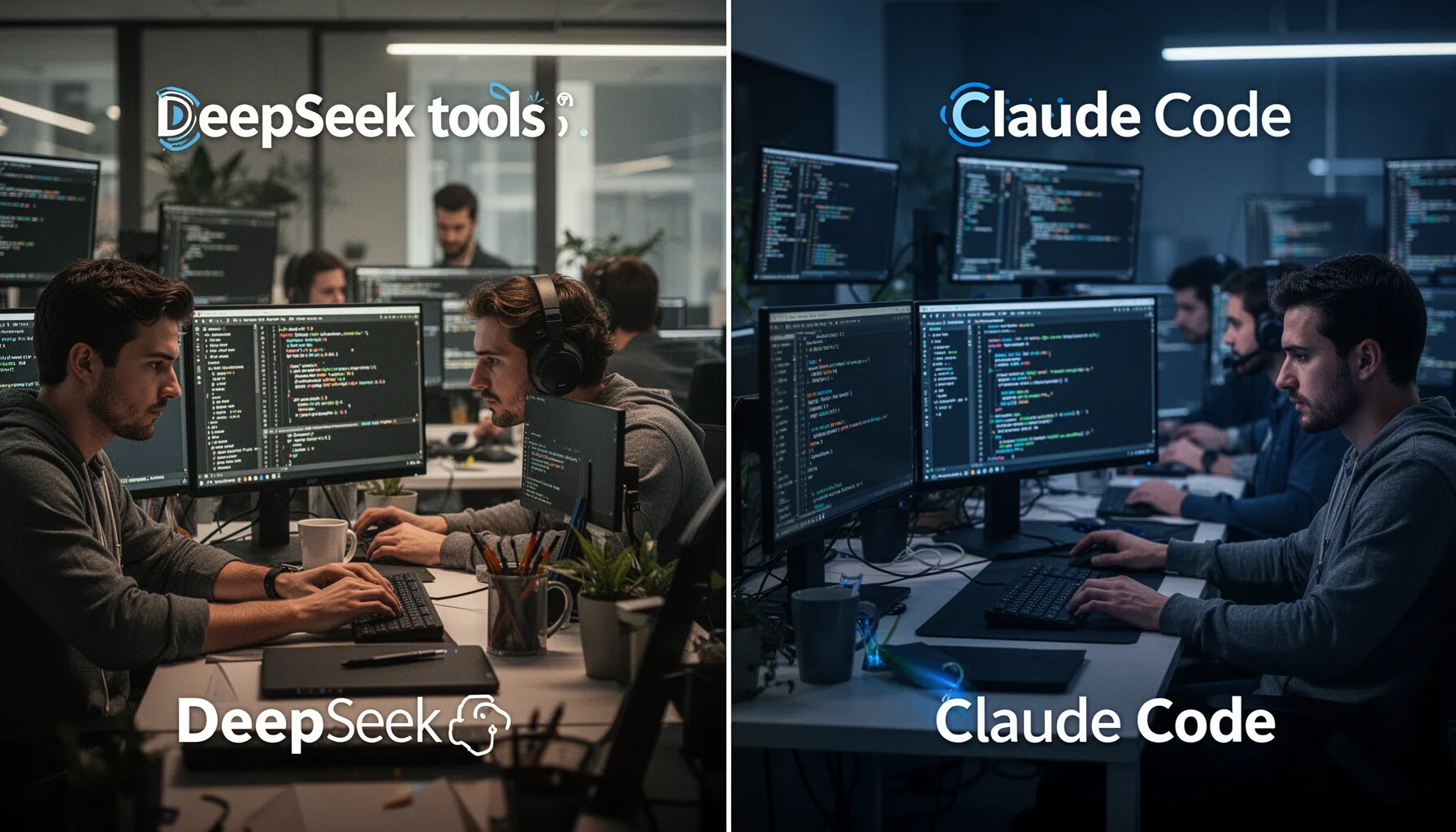
DeepSeek vs Anthropic coding tools could split along price, regional infrastructure, and deployment control rather than pure model quality. Anthropic has brand strength with premium buyers, especially teams that already trust Claude for long-context analysis and careful code edits. But premium positioning creates an opening. If DeepSeek undercuts usage costs while keeping acceptable code quality, it could appeal to startups, outsourcing firms, and enterprises running high-volume coding assistance across support, QA, and internal development. That's consequential. Token economics matter here because coding agents burn inference on repeated tool calls, file reads, and retries, so even modest cost differences can stack up quickly at scale. We've already seen price pressure reshape model adoption in API markets, where lower-cost open-weight or lower-margin models changed procurement conversations almost overnight. And outside the US, deployment preferences matter just as much. Many firms want on-prem, VPC, or region-specific hosting because data residency rules and procurement norms still shape software purchases. That's why I think DeepSeek's best chance isn't to mimic Claude Code feature for feature; it's to offer a cheaper, faster, more locally deployable system that feels built for regional enterprise realities.
What must DeepSeek coding agent rival Claude Code ship to win developers?

To win, a DeepSeek coding agent rival Claude Code must ship a full developer workflow product with trust features, not a model demo dressed up as an IDE add-on. First, it needs repo-scale codebase understanding with accurate file selection and edit planning, because developers hate babysitting the obvious. Second, it needs strong terminal and test-loop execution with reversible actions, clear permission prompts, and useful summaries after each run. Third, it should support enterprise deployment models such as self-hosting, audit logs, SSO, and policy controls, which matter deeply for banks, telecoms, and public-sector buyers. That's where deals get decided. Fourth, it needs multilingual documentation and issue-handling tuned to global and Asian developer environments; a product that understands English-only GitHub workflows leaves money on the table. Cursor and GitHub Copilot succeeded partly because they met developers inside existing habits. JetBrains users, VS Code users, and CLI-heavy engineers all expect slightly different flows. So here's the blunt take: if DeepSeek wants to be taken seriously as a DeepSeek coding agent rival Claude Code, it must ship boring excellence in latency, edit accuracy, test orchestration, and security before it talks about changing software development. Not quite glamorous.
Step-by-Step Guide
- 1
Benchmark against real repository tasks
Start with internal evals that mirror messy production work rather than toy prompts. Use bug fixing, test repair, refactoring, and framework migration tasks across Python, Java, TypeScript, and Go. And measure success with accepted diffs, test pass rates, and time saved, not just benchmark screenshots.
- 2
Build a permission-first terminal agent
Give developers a terminal-native agent that asks before risky commands and explains intent in plain language. Add rollback support, sandbox modes, and per-project policies from day one. That's how trust gets built.
- 3
Optimize for low-latency iterations
Reduce delay on file search, diff generation, and command execution because coding agents feel slow long before they fail. Cache context smartly and avoid re-reading the whole repo on each turn. Developers notice every second.
- 4
Offer flexible deployment models
Ship hosted, VPC, and self-managed options so buyers with compliance rules can still adopt the product. Include audit trails, identity controls, and region-aware storage choices. Enterprise procurement teams will ask for these immediately.
- 5
Design for multilingual engineering teams
Support Chinese and English prompts, logs, docs, and code comments with equal care. Many regional teams work in bilingual environments, and tools that mishandle that reality create friction fast. This is a product wedge, not a side feature.
- 6
Price for high-frequency usage
Set pricing that works for repeated agent loops rather than occasional chat interactions. Bundle usage in ways that make QA, support engineering, and internal platform teams comfortable expanding adoption. A coding agent dies quickly if every test run feels expensive.
Key Statistics
Frequently Asked Questions
Key Takeaways
- ✓DeepSeek needs workflow reliability, not just benchmark scores, to threaten Claude Code seriously
- ✓Hiring and repo signals suggest DeepSeek is probably exploring agentic developer products now
- ✓Price and latency could become DeepSeek's clearest wedge outside the US market
- ✓Enterprise buyers will care about deployment control, auditability, and data residency first
- ✓Claude Code competitors 2026 will win on end-to-end developer experience, not model hype