
⚡ Quick Answer
Mistral 3 vs Claude vs ChatGPT for PrestaShop comes down to one trade-off: sovereignty, workflow fit, and tool control. For EU merchants handling customer data, Mistral 3 often fits stricter residency goals, while Claude and ChatGPT can suit broader support and merchandising tasks when governed through MCP permissions and logging.
Mistral 3 vs Claude vs ChatGPT for PrestaShop isn't just a model shootout. It's a merchant risk call. A slick demo can look brilliant right up until the assistant reads customer addresses, opens return records, and pushes catalog changes without a clean permission boundary. That's where the real story begins. And for European stores, GDPR compliant AI for PrestaShop merchants now sits beside conversion rate, support speed, and margin discipline. Worth noting.
Mistral 3 vs Claude vs ChatGPT for PrestaShop: which model fits real store workflows?
Mistral 3 vs Claude vs ChatGPT for PrestaShop depends less on benchmark bragging rights and more on the work you hand the model inside the store. We'd argue most merchants pick the wrong option because they compare chatbot polish instead of catalog updates, refunds, and ugly order-status edge cases. That's a bigger shift than it sounds. Mistral has picked up speed in Europe partly because enterprises want tighter control over deployment geography and governance posture. That matters. Claude often does well on policy-aware reasoning, which makes it a strong fit for returns explanations, escalation drafts, and messy customer emails with long context. ChatGPT, on the other hand, usually comes out ahead on ecosystem range and integration familiarity, especially when teams already work with OpenAI APIs, assistants, or tool-routing layers in support stacks. For a concrete example, a PrestaShop merchant using MCP Tools Plus can send product-description enrichment to ChatGPT, return-policy summarisation to Claude, and customer-data-sensitive account lookups to a tightly governed Mistral endpoint. Simple enough. According to IBM's 2024 Cost of a Data Breach report, organizations under regulatory scrutiny faced notably higher breach costs, which suggests model choice in commerce should follow data exposure, not fashion.
How GDPR compliant AI for PrestaShop merchants should work by design
GDPR compliant AI for PrestaShop merchants starts with data minimisation, purpose limitation, and a written processor map before any model touches live store records. Too many guides skip that part and jump straight to prompts. That's backwards. Under the GDPR, merchants remain controllers for most customer data processed through support and commerce workflows, so the AI vendor, MCP service, and hosting provider each need a clear role in the chain. That's not optional. The European Data Protection Board has repeatedly stressed transparency, lawful basis, retention limits, and access control in AI-assisted processing, and those points apply directly to order histories, addresses, and complaint threads. Not quite. A sensible setup separates public catalog tasks from customer-account tasks, pseudonymises identifiers where possible, and keeps raw personal data out of prompts unless the workflow truly calls for it. For example, a French PrestaShop fashion retailer could let an AI rewrite product copy from SKU attributes and stock status, yet block that same assistant from reading full support transcripts unless the customer has an active case and the tool call is logged. In our view, the merchant-first rule is simple: if a task can run on catalog metadata, don't send personal data at all. And if it can't, document why, who signed off, and how you'll delete or audit it later. Worth noting.
How MCP Tools Plus PrestaShop integration changes permissions, logging, and risk
MCP Tools Plus PrestaShop integration turns AI from a text generator into an operator, so permission design matters more than model prose quality. Here's the thing. Once a model can query customers, draft refunds, inspect carts, or edit products, the real control plane moves to the tool layer. MCP gives teams a standard way to connect models to external systems, but standardization doesn't equal safety by itself. Merchants need scoped tools such as read_catalog, read_order_status, create_support_draft, and suggest_product_update instead of one broad admin connection that exposes everything. That's the hinge point. A practical pattern is role-based routing: customer-service agents get AI with read-only order and ticket context, merchandisers get catalog and pricing recommendation tools, and finance-sensitive actions stay human-only. Shopify app teams already rely on similar least-privilege patterns across admin APIs, and PrestaShop merchants shouldn't be looser. According to Verizon's 2024 Data Breach Investigations Report, credential misuse and privilege abuse remain recurring factors in incidents, which is why broad MCP permissions create needless blast radius. We'd put it bluntly: if your assistant can do everything, your governance design has already failed. That's a bigger shift than it sounds.
What data sovereignty AI ecommerce Europe teams should require from vendors
Data sovereignty AI ecommerce Europe buyers should ask where inference runs, where logs persist, who can access them, and whether model improvement uses merchant data. Those four questions sort serious vendors from polished sales decks fast. And European merchants increasingly care about EU-hosted options because Schrems II fallout, cross-border transfer scrutiny, and customer trust make data location a board-level issue for some categories. Not every store needs the same level of isolation. But stores handling health-related products, children's data, or complaint-heavy subscriptions should probably set a higher bar. A useful comparison looks like this: Mistral often lands on the shortlist when EU hosting or regional processing matters most; Claude often appeals where reasoning quality on policy text matters; ChatGPT often suits merchants chasing broad tooling, analytics, and operational speed. For instance, a German electronics merchant may choose Mistral for customer-account workflows kept in-region, while using ChatGPT for non-personal merchandising ideation and Claude for policy explanation drafts reviewed by staff. Worth noting. NIS2 and the EU AI Act don't map one-to-one onto every retailer's current stack, but they push governance maturity upward across vendor review and accountability. So the question isn't simply which model is smartest. It's which one keeps your legal exposure proportionate to the business value.
AI governance checklist for online stores using Mistral 3 vs Claude vs ChatGPT for PrestaShop
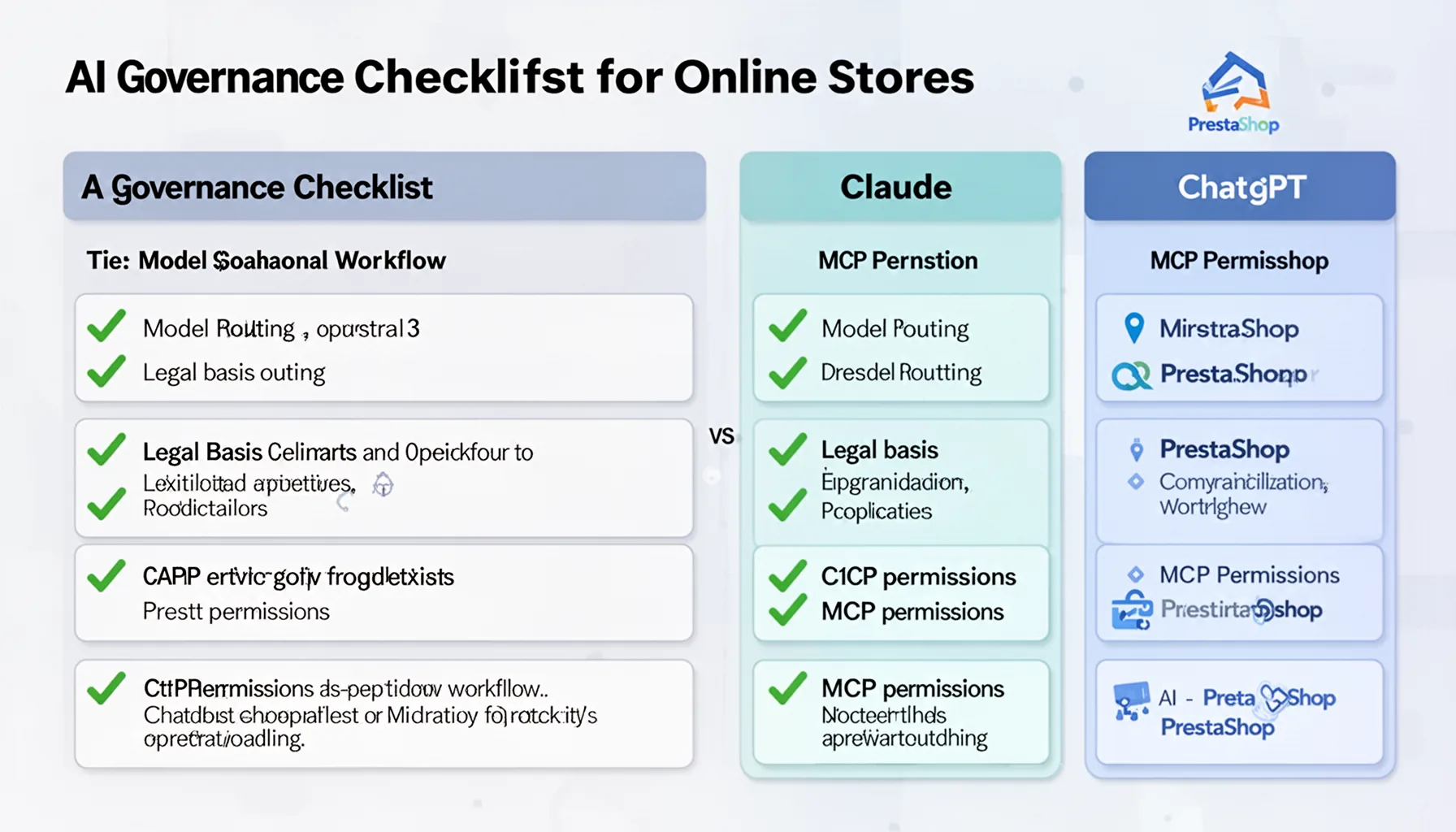
An AI governance checklist for online stores should tie model routing, legal basis, and MCP permissions to each PrestaShop workflow. We think that's the missing piece in most model comparisons, and it's why merchants end up with scattered controls that nobody can audit. Here's the thing. Start with a workflow inventory: catalog enrichment, customer support, returns triage, fraud review, merchandising insights, and internal reporting. Then classify data for each flow as public, internal, personal, sensitive, or payment-adjacent, and assign an approved model plus tool scope for each category. Add logging rules, human review thresholds, prompt redaction, retention windows, and incident procedures, then document processor agreements and transfer mechanisms. Simple enough. A simple risk matrix works well: low risk for product copy on public data, medium risk for support drafts using pseudonymised history, high risk for account-specific recommendations using identifiable order records. One merchant example: route public SEO copy to ChatGPT, route policy-heavy support drafts to Claude with ticket summarisation only, and route customer-identifiable workflows to Mistral in an EU-hosted environment with read-only MCP tools. If you need a north star, link this implementation back to your broader trust playbook in the pillar topic 355 and align sibling work on AI support operations and commerce governance. We'd argue the best AI assistant for PrestaShop customer support is the one your legal, ops, and support leads can all defend in the same meeting. Worth noting.
Step-by-Step Guide
- 1
Map every PrestaShop AI workflow
List each workflow where AI will act or advise, including catalog edits, support replies, returns, and merchandising. Mark whether the model reads only data, proposes changes, or triggers actions through MCP tools. That distinction matters. It tells you where the real operational risk sits before procurement starts.
- 2
Classify store data by exposure level
Tag data as public catalog, internal business, personal customer, sensitive complaint data, or payment-adjacent metadata. Keep the categories simple enough for staff to use without guessing. Then connect each class to approved use rules. A model can't stay compliant if your data labels are fuzzy.
- 3
Assign model-routing rules
Choose which model handles which job based on reasoning need, cost, and residency constraints. Public copy generation may fit one model, while customer-account support may require another with stricter hosting controls. Write those routing rules down. Otherwise teams will improvise under pressure.
- 4
Restrict MCP tool permissions
Expose the minimum tool actions needed for each role and workflow. Prefer narrow functions like read_order_status or draft_refund_note instead of broad admin access. Log every tool call. If a regulator or customer asks what happened, you need evidence rather than memory.
- 5
Define review and retention policies
Set human approval thresholds for high-risk outputs such as refunds, account changes, and policy-sensitive responses. Establish retention windows for prompts, outputs, and tool-call logs, and confirm your vendors support those limits contractually. This part often gets ignored. It's also where weak governance tends to surface later.
- 6
Test with a risk matrix before launch
Run staged tests across low-, medium-, and high-risk scenarios using realistic store data that has been redacted or pseudonymised where possible. Score failure modes such as hallucinated refunds, overbroad data access, wrong-language responses, and unauthorized edits. Fix the control gaps first. Only then should you expand live access.
Key Statistics
Frequently Asked Questions
Key Takeaways
- ✓Mistral 3 usually makes the strongest case for EU data sovereignty requirements.
- ✓Claude often stands out in long-form reasoning across support, returns, and policy-heavy workflows.
- ✓ChatGPT offers broad ecosystem depth, especially when MCP tool orchestration matters.
- ✓MCP Tools Plus should expose the minimum store permissions needed for each task.
- ✓A GDPR-by-design setup beats model hype for serious PrestaShop merchants every time.