
Photonic AI Chip: Can Light Cut Data Center Energy Costs?
See how a photonic AI chip uses light for AI calculations, what Q.ANT and IONOS are testing, and whether it could reduce data center costs.
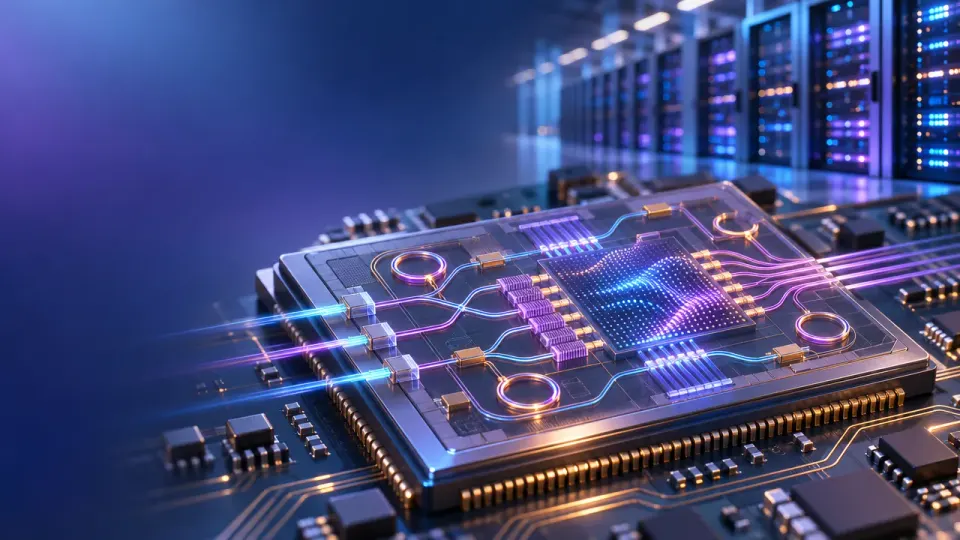
Table of Contents
Quick Answer
A photonic AI chip uses waves of light to perform some AI-related calculations, rather than relying only on electrical signals. Q.ANT and IONOS are testing the technology in a data center pilot, but its real-world performance and energy savings have not yet been established in the article.
The approach is not positioned as a wholesale replacement for GPUs. Rather, photonic processors could take on certain calculations alongside conventional chips, if their potential advantages translate into practical gains in speed, power use and cost.
How a Photonic AI Chip Processes Data With Light
Most AI hardware, including GPUs, moves and processes information through electrical signals in semiconductor circuits. A photonic processor uses waves of light instead. By controlling properties of light as it travels through a chip, the processor can carry out mathematical operations used in computing.
That difference could matter for AI workloads, which involve repeated calculations across large sets of data. In principle, processing with light may allow some operations to happen quickly while using less energy than an electrical approach. Q.ANT’s technology is designed to perform AI-relevant calculations on a photonic chip, rather than simply use optics to move information between electronic components.
The distinction is important: “optical computing” does not automatically mean an entire AI system runs on light. A working data center setup still needs supporting hardware to prepare inputs, handle memory and communicate results. Those parts also consume power and affect overall performance.
Where Photonic Processors Could Help - and What They Won't Replace
Photonic computing is being explored as a way to improve AI chip energy efficiency, including by reducing the power required for particular calculations. It may also produce less heat in some use cases, potentially easing cooling demands. These are potential benefits, not guaranteed savings. The actual result depends on the task, the complete system and how much energy is used by components around the processor.
Photonic processors are also not expected to take over every job performed by GPUs. GPUs are well suited to large volumes of linear mathematical operations, a core part of many AI workloads. Q.ANT’s approach is intended to address calculations that may be more difficult or inefficient for conventional processors, including complex nonlinear operations.
That makes the technology a possible complement to GPUs, rather than a direct substitute. A data center might use different kinds of processors for different stages or types of work. Whether that division is useful will depend on the performance of the photonic chip, how easily it integrates with existing systems and whether it improves costs for real workloads.
For operators, the motivation is increasingly practical. Running more capable AI models requires substantial computing resources, and the electricity needed to power and cool those systems contributes to rising AI data center energy costs. Even a specialized processor could be valuable if it handles a meaningful share of work more efficiently without adding costly complexity elsewhere.
What Q.ANT and IONOS Are Testing in a Data Center Pilot
Q.ANT is working with IONOS on a data center pilot to test its photonic chips in an operating environment. The pilot matters because results from a chip demonstration do not, by themselves, establish how much energy a deployed system will save. Data center testing can help assess how the processor works with surrounding infrastructure and relevant computing tasks.
The key questions are whether it can deliver useful performance on suitable AI workloads, how its power use compares across the full system, and whether it can be integrated reliably. Until those results are available, the energy and cooling advantages remain possibilities rather than proven outcomes at data center scale.
For now, Q.ANT’s photonic AI chip represents an emerging option in the search for GPU alternatives for AI workloads. Its significance will depend less on the promise of computing with light alone than on what the IONOS pilot can demonstrate about real-world performance, energy use and practical deployment.
Step-by-Step Guide
Identify suitable AI calculations
Choose workloads with calculations that may fit a photonic processor, then define the performance and energy benchmarks they must meet.
Measure the full-system baseline
Record current workload performance and energy use across the processor, memory, input handling, communications and cooling.
Integrate the photonic processor
Connect the chip to the supporting hardware and software needed to prepare inputs, run calculations and return results.
Test representative workloads
Run relevant AI tasks under operating conditions and compare their performance and full-system power use with the baseline.
Evaluate deployment trade-offs
Assess reliability, integration effort and operating costs alongside speed and energy results before deciding whether the chip is useful.
Key Statistics
- One data center pilot is described, involving Q.ANT and IONOS.The article identifies their pilot as a test of Q.ANT photonic chips in an operating data center environment; it does not report results.
- The article reports no quantified performance improvement or energy savings for the pilot.No measured figures are provided, so claims about speed, power use, cooling or cost remain potential benefits rather than demonstrated outcomes.
Frequently Asked Questions
What is a photonic AI chip?
Can a photonic AI chip replace GPUs?
Will photonic computing reduce AI data center energy costs?
What are Q.ANT and IONOS testing?
Key Takeaways
- Photonic processors use light to perform selected calculations that conventional chips handle with electrical signals.
- The technology could improve speed or energy use for some workloads, but those benefits depend on the task and the complete system.
- Photonic chips are presented as potential complements to GPUs, not wholesale replacements.
- A data center system still needs supporting hardware for inputs, memory and communications, all of which affect power use.
- The Q.ANT and IONOS pilot will help assess real-world performance, energy use and integration, but no measured results are reported here.