
⚡ Quick Answer
Training environments for visual web agents are the missing infrastructure layer because agents can't improve reliably on a web that keeps changing underneath them. Weblica matters because it aims to make web-agent training more scalable and reproducible than live-site collection or older benchmark setups.
Visual web agents don't mainly suffer from a shortage of ideas. They suffer from shaky places to learn. That's the awkward truth. Weblica, described in arXiv:2605.06761, arrives in a corner of AI where glossy demos can distract from a duller, more consequential snag: researchers still can't train and compare agents cleanly when the web itself won't sit still. And once the environment shifts, the benchmark shifts too. So the larger story here isn't merely another agent paper. It's whether Weblica supplies the missing infrastructure layer that serious web-agent progress has lacked. Worth noting.
Why training environments for visual web agents matter more than another model
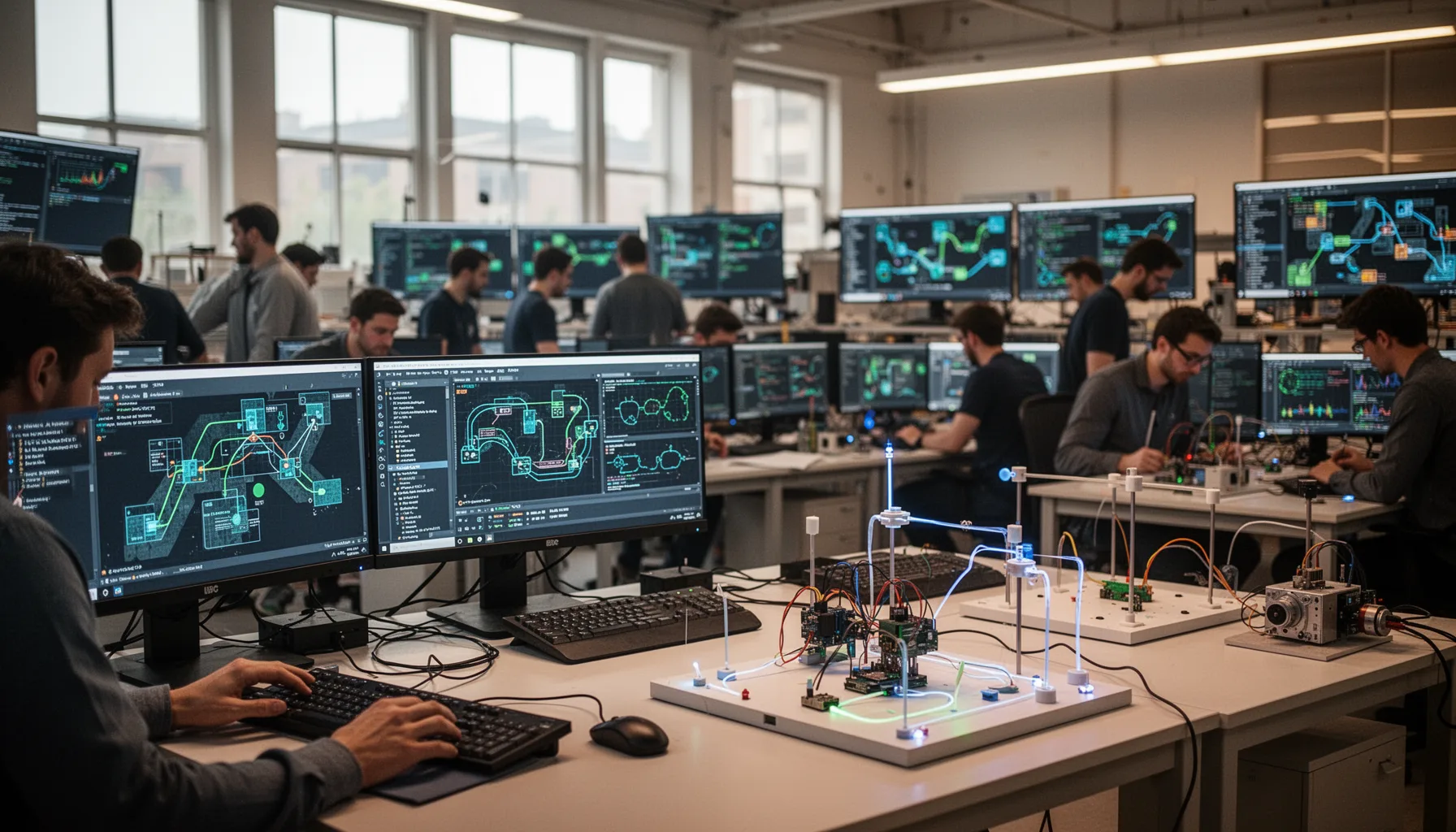
Training environments for visual web agents matter because the environment itself shapes what an agent can absorb and what researchers can actually trust. That's the real issue. Visual web agents deal with rendered pages, layout jumps, pop-ups, latency, form fields, and hidden state, so tiny changes in setup can yield sharply different policies. Small cause, big effect. We've watched this before with Stanford's MiniWoB, which gave the field tidy browser tasks and sped up early work, yet its microworlds never really stood in for messy consumer sites. WebArena pushed much closer to realism by building self-hosted sites for shopping, forums, and content management, and that raised the bar for evaluation. But evaluation by itself won't carry the field. We'd argue researchers have spent too much energy on testing agents and too little on scalable training infrastructure, even though training conditions often decide whether an agent learns durable browsing skill or just fragile benchmark tricks. That's a bigger shift than it sounds.
What is Weblica arXiv 2605.06761 explained in plain terms?

Weblica, in arXiv:2605.06761, put simply, proposes a scalable and reproducible environment layer for collecting and generating training experience for visual web agents. That's the headline. The paper treats the web as open-ended and unstable, which makes offline trajectories and tiny simulated settings feel too thin for broad training. In plain terms, Weblica seems built to give researchers many web-like tasks under controlled conditions, so they can rerun experiments and compare methods without the live internet wrecking repeatability. That matters. A benchmark that mutates every week stops functioning as a benchmark. So the paper's value probably doesn't rest on some flashy new agent architecture. It rests on the wager that better environment design can produce better policies, cleaner ablations, and claims about progress that hold up under scrutiny. We'd say that's the part to watch. Take Google Search UI changes as the obvious real-world reminder.
How Weblica compares with MiniWoB, WebArena, and live-browser data collection
Weblica looks strongest when you stack it against MiniWoB, WebArena, and live-browser data collection on scale, realism, and maintenance burden. Here's the trade-off. MiniWoB is light and reproducible, but its task world stays narrow, so agents often pick up interface habits that don't travel far beyond toy settings. WebArena gets much closer to real workflows and has become a consequential benchmark for agents tested by researchers at Carnegie Mellon, Princeton, and elsewhere, yet realistic self-hosted environments still demand upkeep and still don't fully match the open web's unpredictability. Live-browser collection gives you real pages and fresh states, but reproducibility falls apart fast because sites redesign flows, block automation, or vanish entirely. That's the rub. So Weblica's infrastructure angle matters more than it first appears. If it can mix WebArena-like control with enough diversity to echo the entropy of real browsing, it could fill the middle ground this field has needed for years. Worth noting.
Can scalable web agent training datasets reduce reward hacking and improve transfer?
Scalable web agent training datasets can cut down reward hacking, but only when the environment gives agents enough variation that shortcuts stop paying off. Not quite a silver bullet. Agents trained on narrow tasks often learn spurious cues, like clicking a familiar button position or exploiting deterministic page flows instead of grasping intent. We've seen the same pattern across machine learning benchmarks, and web agents are especially exposed because interfaces contain so many accidental regularities. For a concrete example, an agent that nails a login or checkout flow in one static environment may break the moment a modal appears or labels slide by a few pixels. That's why environment diversity isn't cosmetic. We'd argue Weblica's biggest promise is that it could make agent failures more honest by forcing policies to generalize across layouts, state changes, and task variants rather than memorizing one scripted route through a site. Think Amazon checkout versus a cloned store with slightly shifted forms. That's a real test.
Is Weblica the best framework for visual web agent training yet?
Weblica may become the best framework for visual web agent training if it delivers both reproducibility and enough realism to predict behavior on the real web. That's a big if. The field doesn't need another polished demo environment. It needs an experimental substrate other labs can run, extend, and stress-test without heroic setup work. Broader ML benchmarking has already suggested that reproducibility, transparent task definitions, and comparable evaluation protocols usually beat one-off demos over time. And the hard test for Weblica won't be whether agents post strong scores inside Weblica itself. It will be whether models trained there transfer better to uncontrolled browsing than models trained on older setups or static trace datasets. That's the standard that matters. Training environments for visual web agents become useful infrastructure only when they shrink the sim-to-real gap, and Weblica stands out because it goes straight at that neglected layer. We'd argue that's where the real story sits.
Key Statistics
Frequently Asked Questions
Key Takeaways
- ✓Weblica shifts the story away from model hype and toward infrastructure that agents actually need
- ✓Reproducible web environments matter because live sites break benchmarks and muddy comparisons
- ✓MiniWoB, WebArena, and live browsing each address part of the problem, not the whole thing
- ✓Training environments shape agent behavior, reward shortcuts, and influence real-world transfer
- ✓If Weblica works as advertised, it could narrow the sim-to-real gap in a meaningful way