
AI Agents Blocked by Websites: What Yelp's Data Licenses Mean
See why websites are blocking AI agents, how Yelp's data licenses work, and what partnerships mean for safer AI-powered shopping.
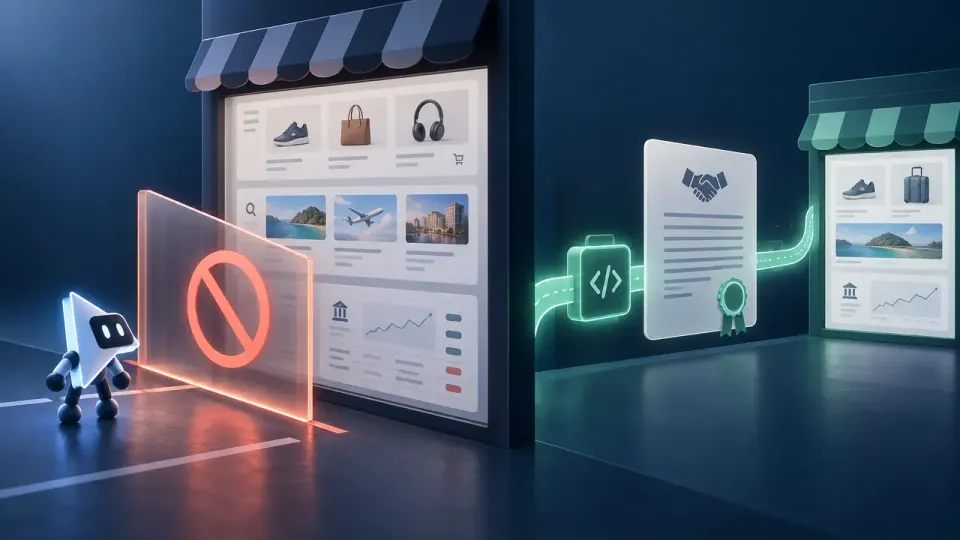
Table of Contents
Quick Answer
Websites are restricting AI agents because automated access can create privacy, security, transaction, and accountability risks. Some companies block or limit agents, while others, including Yelp and retail partners, offer licensed or approved ways to access data and services.
That distinction matters. A site may block an agent deliberately, or its existing anti-bot protections may mistake the tool for unwanted automated traffic. For users, either can stop an agent from completing a task. For businesses, the question is whether to deny access, license data, or build partnerships that allow specific uses.
Where AI agents are reportedly hitting website blocks
According to The Verge, users have encountered problems when agents try to navigate websites and complete tasks. Cars.com and Amtrak were among the sites users said had become inaccessible to agents. The reports describe access failures, not necessarily confirmed company-wide policies against every AI tool.
Delta’s position is more specific: the airline is reportedly preventing agents from booking flights. That kind of restriction limits an agent’s ability to move from researching options to making a purchase on a customer’s behalf.
Why banks and travel sites are restricting agent access
Financial companies have raised particular concerns about letting outside agents act inside customer accounts. JPMorgan Chase has said external AI agents are too risky for clients. Charles Schwab has said it does not allow agents such as Meta Muse to access accounts and take actions on customers’ behalf.
The risks are practical as well as technical. An agent could expose sensitive information, make an unauthorized transaction, or misunderstand an instruction. Companies also need to determine who is responsible if an automated action causes a loss or disrupts an account. Blocking access gives the institution more control over how customers’ money and personal data are handled.
Travel bookings pose a different but related challenge: an agent may select or purchase an itinerary, potentially creating charges or changes that the customer did not intend. Restrictions can prevent those actions, even when the customer wants the agent to help.
Licensing and retail partnerships offer another path
Yelp represents a more structured approach. Rather than treating access as unrestricted, it has a data-licensing program through which AI companies can obtain Yelp information under agreed terms. Licensing gives the business a way to define how its data is used, instead of relying only on public website access.
Retail partnerships offer another route. The Verge has reported that Meta has worked with Walmart, Gap, and Best Buy on shopping experiences involving Muse. Separately, Shopify is opening its product catalog to more AI agents. These efforts suggest some businesses see agents as a new way to connect shoppers with products, provided access happens through an approved arrangement.
The approaches are not interchangeable. A data license governs use of information; a retail partnership can shape the shopping experience; and an account restriction prevents an agent from acting in a sensitive environment. Each reflects a different level of access and control.
What to watch as websites decide who can act for customers
The rules are still taking shape. Some blocks may be explicit policies, while others may result from anti-bot systems that were not designed to distinguish a customer’s agent from scraping or abusive automation. That makes access unpredictable, even when a site has not publicly announced a ban.
The tension is commercial as well as technical. Companies may want to reach customers through AI-assisted shopping, but also protect data, prevent unwanted transactions, and decide which agents can represent users. The next phase of agent-driven commerce will depend not just on what agents can do, but on what websites permit them to do - and on whose terms.
Key Statistics
- The article names two financial institutions that restrict or warn against external AI agents: JPMorgan Chase and Charles Schwab.These are examples reported in the article, not a survey of financial institutions. The concerns cited involve agents accessing accounts and taking actions for customers.
- Three retail brands are named in connection with Meta shopping experiences: Walmart, Gap, and Best Buy.The Verge is cited for reporting these collaborations involving Muse. The examples illustrate approved retail partnerships, not the total number of Meta partners.
- Two websites named in user reports of agent access problems are Cars.com and Amtrak.The Verge is cited for reporting these user experiences. The article notes that access failures do not necessarily establish formal company-wide bans.
Frequently Asked Questions
Why are websites blocking AI agents?
Does a website error mean AI agents are formally banned?
How does Yelp allow AI companies to use its data?
Can AI agents book flights or access financial accounts?
How can businesses give AI agents approved access?
Key Takeaways
- Reported agent access failures do not always prove a website has announced a formal ban; anti-bot systems may also block automated tools.
- Financial institutions and travel companies may restrict agents to reduce the risk of unauthorized actions, exposed information, or unintended purchases.
- Yelp's data-licensing program offers AI companies access under agreed terms rather than unrestricted website access.
- Retail partnerships can give agents an approved way to connect shoppers with products and services.
- Website access rules are still developing, so agent capabilities depend on what each business permits and under what conditions.