
AI Reasoning Repair Framework: How SAT Teams Solve More
See how the AI reasoning repair framework helps agents audit and fix one another's work, and what SAT's benchmark results reveal.
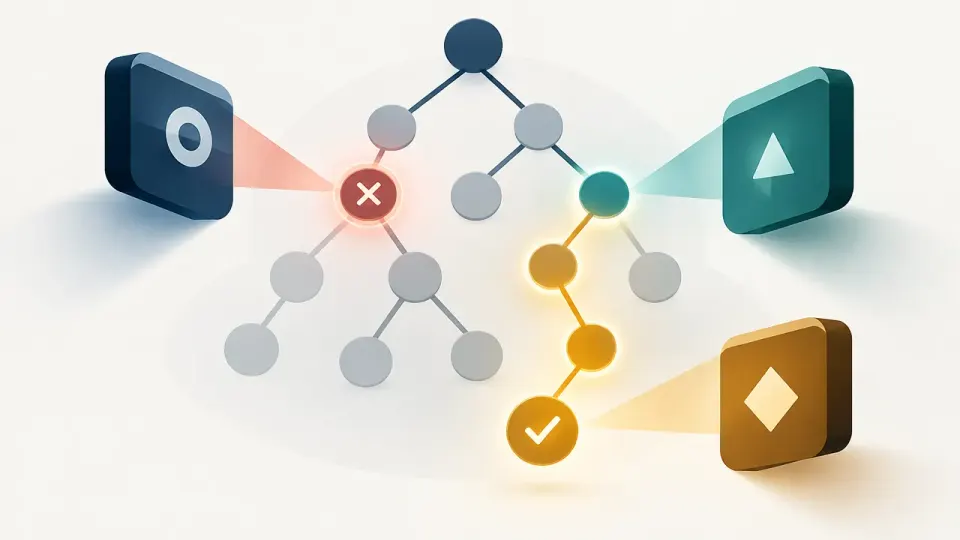
Table of Contents
Quick Answer
Self-Organizing Agent Teams (SAT) is an AI framework that trains agents to divide tasks, audit teammates' reasoning, and repair errors instead of only selecting among independent answers. The research team reported 71.2% accuracy on AIME 2026, outperforming its strongest individual model and a perfect routing oracle.
The approach produced a reported 71.2% accuracy on AIME 2026, a mathematics benchmark. That was 29 percentage points above the team’s strongest individual model and 13.4 points above a perfect routing oracle - a system that selects among separate model outputs. The findings suggest that the way models work together can matter as much as which model is chosen.
How SAT teaches AI agents to work as a team
SAT trains agents to use reusable strategies for collaboration. These include how to structure a conversation, assign specialized roles, and review or correct another agent’s work. Rather than treating each model response as an isolated result, the framework organizes agents into a team with a process for solving problems.
That process can include agents approaching a problem from different roles and then evaluating the reasoning produced by their teammates. When an agent spots a flaw, the group can try to repair the reasoning instead of simply selecting a different answer. The goal is to make collaboration itself a learned capability - not just to run multiple models in parallel.
How peer auditing and repair differ from debate and model routing
In multi-agent debate, models typically propose candidate answers, critique one another, and revise their responses. Debate can expose errors, but SAT focuses more directly on learning how the team should work: who should do what, how the exchange should be structured, and how to audit and repair the reasoning.
Routing systems take a different approach. They choose among outputs from individual models, without having those models jointly develop and correct a solution. SAT’s reported advantage over a perfect routing oracle is notable because it suggests that team interaction can produce a better result than simply picking from independent answers.
What the benchmark results show - and what they do not
The research report says SAT outperformed the strongest individual model and a perfect router across five mathematics and physics benchmarks. Its AIME 2026 result offers a concrete example: SAT reached 71.2% accuracy, exceeding its strongest individual team member by 29 percentage points and the routing oracle by 13.4 points.
These are benchmark findings, not evidence that collaboration will improve every AI system or every task. Results can depend on the models involved, the problem type, and how the evaluation is designed. The findings also do not establish that agents will reliably identify and fix one another’s errors in open-ended, real-world use.
Still, SAT points to a useful direction for multi-agent AI reasoning. If agents can learn effective roles and review each other’s work, a team may solve problems that its members struggle with alone. Further testing will show how broadly that advantage holds. Explore more research on multi-agent AI reasoning and how teams of AI agents can improve problem-solving.
Step-by-Step Guide
Assign complementary agent roles
Organize agents around distinct responsibilities, such as solving the problem, checking assumptions, or reviewing calculations, rather than asking each to produce an interchangeable answer.
Structure the collaboration
Set up an exchange in which agents can share their work and findings, so the team can build on and assess one another's reasoning.
Audit the reasoning
Have a reviewing agent inspect the solution's logic and identify specific assumptions, steps, or calculations that may be flawed.
Repair and evaluate the solution
Ask the team to address identified flaws and assess the final result against an appropriate benchmark, while comparing it with individual-model and routing baselines.
Key Statistics
- 71.2% accuracy on AIME 2026The research report from the team at Stanford University, Together AI, and Emory University gives this result for Self-Organizing Agent Teams.
- 29 percentage points above the strongest individual modelThe research report's AIME 2026 comparison places SAT's 71.2% result 29 percentage points above its strongest individual team member.
- 13.4 percentage points above a perfect routing oracleThe research report says SAT exceeded a routing system that selects among separate model outputs by 13.4 percentage points on AIME 2026.
- Outperformed the strongest individual model and a perfect router across five benchmarksThe research report describes results across five mathematics and physics benchmarks; the article does not provide the individual scores for all five.
Frequently Asked Questions
What is the Self-Organizing Agent Teams framework?
How does SAT differ from multi-agent debate?
How did SAT perform on AIME 2026?
Why is SAT's comparison with a perfect routing oracle significant?
Does SAT prove that AI agents can reliably fix one another's mistakes?
Key Takeaways
- SAT trains agents to organize collaboration through task division, role assignment, review, and reasoning repair.
- Unlike model routing, SAT has agents work together to develop and correct solutions rather than simply selecting an individual model's output.
- The research team reported 71.2% accuracy on AIME 2026, 29 percentage points above its strongest individual model.
- SAT also exceeded a perfect routing oracle by 13.4 percentage points on AIME 2026, according to the research report.
- The results cover five mathematics and physics benchmarks, but do not prove that collaboration improves every model or real-world task.