
AI Code Review Workflow: Catch Defects Without More Work
Build an AI code review workflow that catches defects, routes risky changes to humans, and reduces noisy comments without slowing delivery.
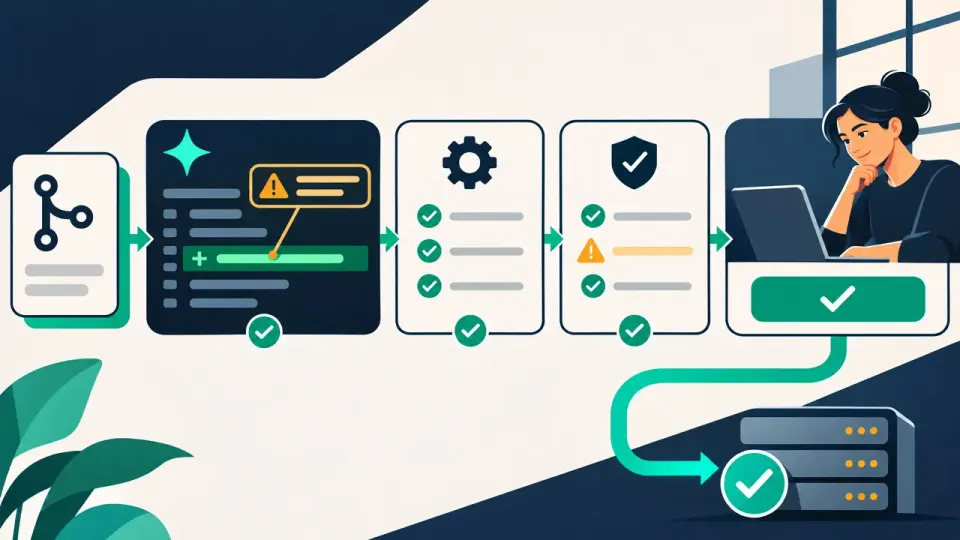
Table of Contents
Quick Answer
An effective AI code review workflow uses independent review, risk-based routing, and existing CI checks to catch defects without overwhelming engineers with low-value comments. Keep human approval for consequential changes and expand automation only when quality and workload measures support it.
A useful AI code review workflow is not a second flood of comments or a substitute for engineering judgment. It is a way to catch likely defects early, route changes to the right level of scrutiny, and keep review effort proportional to risk.
Define what AI review should - and should not - approve
Treat AI review as one layer in your quality process, alongside tests, security scanning, repository rules, and human review. Decide which findings the system can report, which checks must pass, and which decisions remain with a person.
An AI reviewer can flag a possible null-handling issue, point out a missing test, or identify a change that appears to bypass an established pattern. It should not automatically be treated as proof that a change is safe. Review comments are signals to verify, not guarantees.
Independence does not require a different vendor or model in every case. The important distinction is between the generation task and the review task: give the reviewer a clear mandate to challenge the implementation, examine edge cases, and cite the affected code. Keep human reviewers responsible for interpreting consequential findings.
Policies should be specific enough to apply consistently. State which files or systems are sensitive, what checks are mandatory, and whether the AI can suggest a fix or approve a change. Some newer tools support natural-language approval rules and configurable signals, but the policy itself still needs to reflect your team's risk tolerance. Do not let a tool's default settings define it for you.
Route pull requests by risk, not by review volume
A risk-based code review process gives routine changes a lighter path and reserves more attention for changes with greater potential impact. Route work based on factors such as affected service, data sensitivity, size of the change, test coverage, and whether the code alters a public interface or security boundary.
For instance, an isolated copy edit with no executable code may need standard automated checks and a quick review. A database migration that changes how customer records are stored should receive careful human review, even if the diff is small. Lines changed alone are a poor measure of risk.
Make the routing visible in the pull request. Explain why a change was escalated, what checks remain, and who must approve it. That helps engineers understand the process and makes it easier to correct overly broad or narrow rules.
Make AI review one part of the CI quality gate
AI review should complement, not replace, automated checks that produce repeatable results. Run builds and tests on each change. Add security scans, dependency checks, formatting rules, and policy enforcement where appropriate. A reviewer can call attention to a likely defect, but a failing test or blocked policy should have a defined effect on merge eligibility.
Some teams also experiment with self-healing CI, in which an agent proposes a fix after a check fails. Keep the boundary clear: a proposed patch should run through the same checks as any other change. If an automated repair is uncertain, broad, or touches sensitive code, send it to an engineer rather than allowing it to merge on its own.
Reduce review noise by optimizing for useful findings
More AI comments do not mean better review. Excessive low-confidence warnings can train engineers to ignore the reviewer, including when it catches something important. Configure the system to prioritize concrete correctness, security, and reliability risks. Suppress repetitive style advice when linters or formatters already handle it.
The goal is not to maximize the acceptance rate either. A high rate could mean useful findings, or it could mean reviewers accept suggestions without checking them. Pair comment outcomes with quality measures and direct feedback.
Roll out gradually and measure quality alongside review workload
Start with one repository and a human-visible AI review step. Keep existing CI safeguards in place, and agree in advance which changes require human approval. Compare results with the current process before expanding to additional repositories or automatic approvals.
Track both quality and workload. Useful measures include:
- Incidents associated with changes, including severity and affected area
- Revert frequency and the reasons for reversions
- Time spent waiting for review and overall change cycle time
- The share of AI comments engineers act on, reject, or report as incorrect
- CI failures caught before merge and recurring flaky checks
Interpret these measures together. Faster reviews are not a win if incidents or reverts rise. More comments are not a win if engineers spend longer sorting through low-value feedback. Establish acceptable limits, then pause or narrow automation if outcomes move outside them.
Expand automation only when the evidence supports it. A practical progression is to begin with suggestions, add risk-based routing once the rules are reliable, and consider automatic approval only for narrowly defined changes with strong checks and clear rollback paths. Keep high-impact decisions with accountable people.
The best AI code review workflow is the one that catches meaningful defects without shifting the cost to engineers as extra noise. Start small, define approval boundaries, and use quality and workload outcomes - not review volume - to decide what to automate next.
Step-by-Step Guide
Define AI review boundaries
Specify what the AI reviewer may flag or suggest, which checks must pass, and which decisions require an accountable human.
Separate generation from review
Use a distinct review task with access to the diff, tests, and repository conventions. Ask it to challenge the implementation, identify affected code, and explain potential failures.
Route changes by risk
Set repository rules that escalate sensitive areas such as authentication, payments, data retention, and deployment configuration to named human approvers.
Connect review to CI checks
Run tests, security scans, dependency checks, and policy enforcement alongside AI review. Keep proposed automated fixes subject to the same checks as other changes.
Reduce low-value findings
Prioritize concrete correctness, security, and reliability risks. Suppress repetitive style advice already covered by linters or formatters, and review whether engineers find comments useful.
Pilot and evaluate the workflow
Start in one repository with existing safeguards intact. Compare incidents, reverts, review time, comment outcomes, and CI results before expanding automation.
Key Statistics
- Nearly half of participating engineers and leaders said the agents that write their code also review it.The article cites a survey but does not identify its publisher, sample size, or field date, so the figure should be verified against the original survey before external publication.
- The article recommends tracking five review and quality measures: incidents, reverts, review and cycle time, AI comment outcomes, and CI failures.This count comes from the article's rollout checklist; it is a proposed measurement framework, not a benchmark or reported industry result.
- The article describes a three-stage automation progression: suggestions, risk-based routing, and narrowly scoped automatic approval.This sequence is the article's recommended rollout approach. Automatic approval is presented as conditional on strong checks, clear boundaries, and rollback paths.
Frequently Asked Questions
What is an AI code review workflow?
Should AI review code written by an AI coding agent?
How should teams decide which code changes need human review?
How can teams reduce noisy AI code review comments?
Key Takeaways
- Treat AI review comments as findings to verify, not proof that a change is safe.
- Separate code generation from review so the reviewer can challenge assumptions and inspect edge cases.
- Route changes by factors such as data sensitivity, affected systems, test coverage, and security boundaries, not diff size alone.
- Use AI review alongside repeatable tests, security scans, repository policies, and human approval requirements.
- Measure defects and workload together, including incidents, reverts, review time, and the usefulness of AI comments.