
AI World Models: How Agents Predict and Plan Ahead
AI world models help agents predict how environments respond to actions. Learn how imagined rollouts improve planning, navigation, and safer decisions.
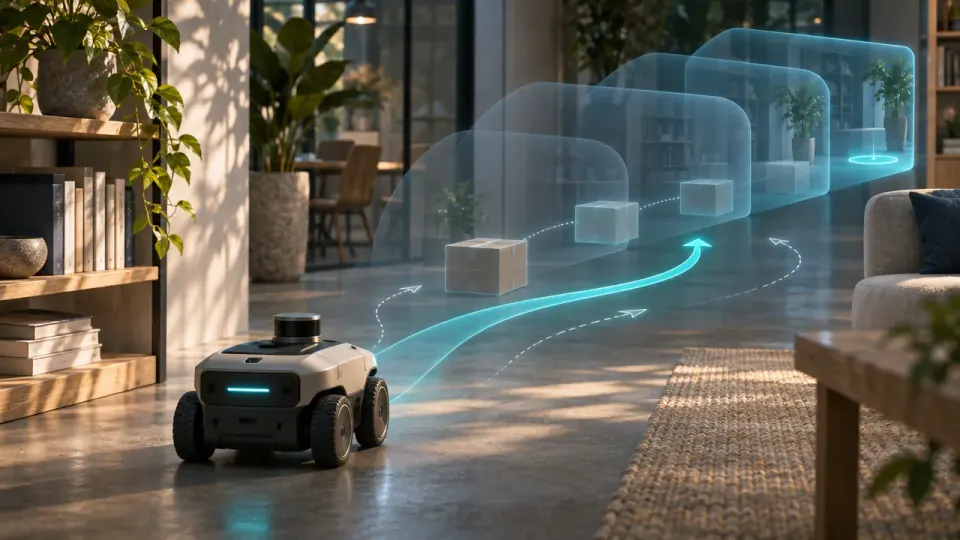
Table of Contents
Quick Answer
AI world models are learned representations that help agents predict how an environment may change, including the effects of their actions. Agents use those predictions to compare possible futures and choose actions before acting in the real world.
Instead of relying only on the latest observation, an agent can use a world model to consider possible futures before acting. This can support more deliberate navigation, reduce the need for trial and error in the real environment, and help the agent adapt as conditions change. The quality of those decisions, however, depends on how well the model predicts the world it encounters.
What an AI World Model Represents
An AI world model is a learned representation of an environment and its dynamics. It captures patterns that help an agent estimate what may happen next: how objects move, how a scene changes, or what consequence may follow from a particular action.
The model often does not store every visual detail. Instead, it may encode observations - such as camera images or sensor readings - into a compact internal state. That state preserves information useful for prediction and decision-making. For a mobile robot, it might represent its position, nearby obstacles, and the likely movement of objects in its path.
This is different from simply recognizing what is in an image. Recognition might identify a chair; a world model aims to predict how the scene will change if the robot turns, moves forward, or waits. In that sense, AI world models give agents a way to reason about consequences, not just describe what they currently observe.
How Agents Use World Models to Predict and Choose Actions
A common cycle looks like this:
For example, a delivery robot nearing a crowded intersection could predict the likely results of moving now, slowing down, or taking another route. It can compare those options based on expected progress and risk, then take one action. The new sensor input helps it check whether the prediction was accurate and informs its next decision.
This is a form of model-based reinforcement learning: an agent uses a model of the environment to help it learn or plan, rather than relying only on experience gathered by acting directly in that environment. The model does not need to predict everything perfectly. It needs to provide useful estimates for the decisions the agent has to make.
How Imagined Rollouts Help Agents Plan
Once an agent can predict likely outcomes, it can run imagined rollouts - sequences of possible actions and predicted states - before committing to an action in the real world. It can ask, in effect: “If I turn left, what might happen next? What if I wait?” The agent then compares the options and chooses a promising path.
This can make exploration more efficient. Testing every possibility with a physical robot may take time, wear equipment, or create safety risks. Predictions let the agent evaluate some options internally first. They are not a guarantee of success: if the model’s predictions are wrong, a plan based on them can also be wrong.
MuZero demonstrates a related but distinct approach. It learns to predict information useful for planning, such as rewards and the consequences relevant to choosing actions, without reconstructing every detail of the environment. This illustrates an important design choice: a world model can focus on what a task requires, rather than attempting to create a complete copy of reality.
How World Models Help Agents Navigate and Act in the Physical World
Navigation depends on more than knowing where things are. An agent needs to anticipate how its own movement will change its position and viewpoint, and how the environment may change while it moves. A robot may need to account for a moving person, a door that could close, or a route that becomes blocked.
A predictive environment model can help the agent compare actions in context. It could estimate whether moving around an obstacle is safer than passing close to it, or whether a longer route is more reliable than a crowded shortcut. For embodied agents, including robots, models can also support training in simulated or generated environments before deployment. That gives developers a way to test a wider range of situations than may be practical to reproduce in the physical world.
Still, success in simulation does not automatically transfer to reality. A simulated floor, camera, or moving object may behave differently from its real counterpart. The model’s predictions need to be tested against real observations, especially in settings where mistakes could cause harm.
What World Models Can and Cannot Do
A language model is primarily trained to predict and generate text. It can explain a route or interpret instructions, but that does not automatically give it a reliable, grounded model of how a robot will move through a particular space. Systems can combine maps, language models, sensors, and world models, with each contributing different capabilities.
Models can also struggle with unfamiliar situations or rare events that were poorly represented in training. Practical systems need ways to recognize uncertainty, check predictions against new observations, and respond cautiously when conditions differ from expectations. For physical applications, simulation should complement real-world testing and safety measures, not replace them.
AI world models can make agents more proactive by helping them predict and compare possible outcomes before acting. Their value depends on whether those predictions are useful and reliable in the environments where the agents operate. To explore how prediction becomes a decision-making strategy, read our guide to model-based reinforcement learning: how agents learn by planning.
Step-by-Step Guide
Encode the current observation
Convert camera images, sensor readings, or other inputs into an internal state that preserves information relevant to the task, such as the agent's position and nearby obstacles.
Predict outcomes for candidate actions
Use the learned environment model to estimate how the state could change if the agent moves, waits, turns, or takes another available action.
Compare possible futures
Evaluate predicted outcomes against the task goal, including factors such as progress, safety, and likely risk.
Choose and execute an action
Select a promising option and carry it out in the environment, rather than treating the model's prediction as a guaranteed outcome.
Check the prediction and update
Compare what actually happened with the predicted result, use the new observation to inform the next decision, and respond cautiously when the model is unreliable.
Key Statistics
- MuZero achieved state-of-the-art results across 57 Atari games.The MuZero research team reported this result in its 2020 Nature paper, demonstrating how learned predictions of task-relevant outcomes can support planning across a suite of games.
- DreamerV3 was evaluated across more than 150 diverse tasks and demonstrated the ability to obtain a diamond in Minecraft from visual input.Hafner and co-authors reported these results in their DreamerV3 research. The findings illustrate the range of tasks explored with a learned world model; they do not guarantee performance in every real-world setting.
Frequently Asked Questions
What is an AI world model?
How do world models help AI agents plan?
What is an imagined rollout in AI?
How are AI world models different from maps?
Can AI world models make robot navigation safer?
Key Takeaways
- World models represent useful features of an environment and its dynamics, rather than necessarily recreating every detail.
- Agents can predict outcomes for candidate actions, compare those outcomes with a goal, and then act.
- Imagined rollouts let agents evaluate possible action sequences without testing every option in the physical environment.
- DreamerV3 and MuZero illustrate different ways learned models can support planning and decision-making.
- Prediction errors, unfamiliar situations, and simulation-to-reality gaps can undermine plans, so agents need feedback and real-world testing.