
Context Lake vs Vector Database: Choose the Right AI Stack
Compare context lakes and vector databases to choose an enterprise AI architecture for retrieval, reasoning, freshness, security, and scale.
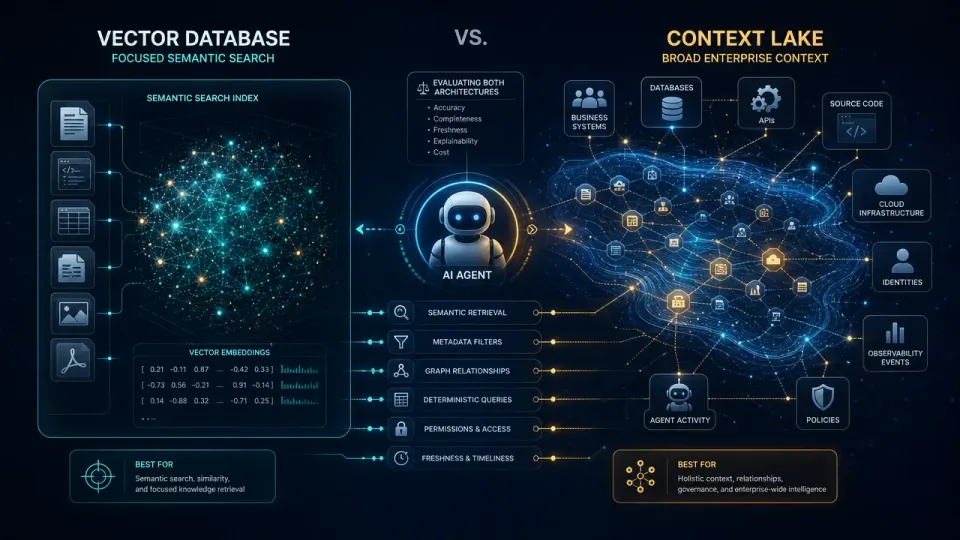
Table of Contents
Quick Answer
A vector database is best for semantic retrieval across documents, while a context lake is better for agents that need connected, current, authorized data across enterprise systems. Many production architectures combine both: vector search for unstructured evidence and structured queries, graphs, APIs, and event data for exact context and actions.
For document question answering, the answer may be a vector database. For autonomous agents operating across applications, infrastructure, code, and business processes, the answer may be a context lake. In many enterprise environments, however, the strongest design combines both.
The important choice is not which technology is newer. It is what kind of context your workloads must retrieve, how much reasoning they require, and how safely the system must act on the result.
What a Vector Database and a Context Lake Are Designed to Solve
A typical Retrieval-Augmented Generation (RAG) pipeline works like this:
This approach is effective for questions such as:
- “What is our parental leave policy?”
- “How do I configure this product?”
- “Summarize the latest customer onboarding guidance.”
- “Which troubleshooting steps apply to this error message?”
Vector search is fundamentally a semantic retrieval system. It helps locate relevant passages in large collections of unstructured or semi-structured content. Most enterprise implementations also combine it with keyword search, metadata filters, access-control filters, reranking, or document-level permissions.
However, similarity is not the same as truth, authority, or relationship. A highly similar passage may be obsolete, apply to a different product version, or describe a system the requesting employee is not allowed to access.
Potential sources include:
- Business applications and operational databases
- Service catalogs and asset inventories
- Identity and access systems
- Source-code repositories and dependency metadata
- Cloud and infrastructure platforms
- Observability, incident, and alerting systems
- Customer, account, and contract records
- Policies, procedures, and other documents
- Agent conversations, actions, and task state
The defining feature is not simply having a large amount of data. It is organizing that data into usable, connected context. An agent might need to know that a failing service is owned by a particular team, depends on a specific database, was changed by a recent deployment, has an active incident, and is governed by a policy that limits the actions it may take.
A context lake can represent these facts through relational models, knowledge graphs, event stores, document indexes, metadata catalogs, or a combination of technologies. It is best understood as an architectural pattern for managing context rather than as one mandatory database product.
How Retrieval Works in Each Architecture
The retrieval method should match the question.
Its strengths include flexible natural-language search, strong performance across large text collections, and relatively simple integration with generative models.
A query could combine semantic search with filters such as “only current policies,” “only documents for Product A,” and “only records the user can access.”
GraphRAG combines graph structure with language-model workflows. The graph can provide entities and relationships, while text retrieval supplies explanations, procedures, or evidence.
A language model should not infer these facts from semantically similar text when a system of record can provide them directly.
This is the central distinction in the context lake vs. vector database discussion: vector retrieval finds relevant content, while structured retrieval helps establish what is connected, current, authorized, and actionable.
Why Semantic Similarity Alone Can Fail Enterprise Agent Tasks
Semantic similarity is powerful, but enterprise tasks frequently contain constraints that embeddings do not capture reliably.
These limitations do not make vector databases unsuitable. They define where vector search should be supplemented by structured context, deterministic queries, or both.
Compare the Architectures Against Enterprise Requirements
A vector database is often easier to deploy and evaluate. A context lake demands more work: source integration, entity resolution, schema design, lineage, governance, and operational maintenance. That investment is justified when agents must reason over organizational and operational relationships.
When a Vector Database Is the Right Choice
Choose a vector database as the primary retrieval layer when the workload is mainly document-centric and the required answers can be supported by text.
Good use cases include:
- Internal policy and knowledge-base search
- Customer-support answer drafting
- Product documentation assistants
- Contract or research discovery
- Semantic search across technical manuals
- First-generation RAG applications
- Content recommendation and classification
A vector architecture is especially suitable when the source material is relatively stable, relationships are not central to the task, and a human reviews the output before action is taken.
For example, an employee assistant that retrieves current benefits policies may need document permissions, effective dates, and metadata filters. It does not necessarily need a graph of every employee, payroll system, manager relationship, and business process.
Even in this simpler scenario, build for quality. Use sensible chunking, preserve document structure, attach source and version metadata, apply permission filters before generation, and evaluate retrieval separately from answer quality. Hybrid keyword-plus-vector search is often more reliable than semantic search alone, especially for product codes, error identifiers, legal terms, and names.
When a Context Lake Is the Better Foundation
A context lake becomes more valuable when the agent must understand a changing environment and coordinate actions across systems.
Typical use cases include:
- Autonomous or semi-autonomous engineering agents
- Incident investigation and remediation
- Cloud cost and reliability optimization
- Security operations and threat analysis
- Business-process orchestration
- Customer operations spanning multiple applications
- Supply-chain and asset intelligence
- Compliance workflows requiring evidence and lineage
Consider an engineering agent asked to investigate a production latency spike. It needs more than similar incident reports. It may need to connect an alert to a service, service to an owner, owner to an escalation policy, service to recent code changes, code to a deployment, deployment to infrastructure, and infrastructure to related metrics. It must then retrieve the correct runbook and determine whether it has permission to restart anything.
That is a context-management problem. A vector database can contribute historical incidents and runbook retrieval, but it is not by itself the complete enterprise AI data architecture.
The same principle applies to business agents. An order-resolution agent may need to connect a customer, contract, shipment, payment status, support history, inventory position, and approval policy. The agent needs trusted relationships and current state before it recommends a remedy.
Why a Hybrid Vector and Structured Context Architecture Often Wins
Most enterprises do not need to choose between semantic retrieval and structured context. They need clear boundaries between them.
A hybrid design might include:
- A vector index for manuals, policies, tickets, conversations, and code documentation
- A graph or relational layer for entities and relationships
- Operational APIs for current state and transactional actions
- An event pipeline for changes, alerts, and agent activity
- A metadata and lineage catalog for provenance
- A policy layer for identity, permissions, and allowed actions
- An orchestration layer that selects retrieval tools based on the task
For a change-management agent, structured retrieval could identify affected services and approval requirements. Vector retrieval could find the relevant implementation procedure and lessons from previous changes. A live API could confirm deployment state. The policy layer could prevent execution without required authorization.
This design also limits unnecessary complexity. Not every document needs to become a graph node, and not every structured record needs to be embedded. Store and retrieve each type of context in the form that preserves its useful meaning.
An Implementation Roadmap
Start with the workloads, not the database. Select two or three representative tasks and document the context each one requires. Include the expected answer, source of truth, freshness, permissions, and acceptable failure modes.
Next, inventory source systems and classify their data as unstructured content, structured records, relationships, events, or live operational state. Establish ownership and lineage before building retrieval pipelines.
Then create a minimum shared model for important entities such as users, teams, services, applications, customers, assets, documents, incidents, and policies. Resolve identifiers across systems so that “service A” means the same thing everywhere.
Connect semantic and structured retrieval incrementally. Test vector search for documents, deterministic queries for exact facts, graph traversal for relationships, and APIs for live state. Add an orchestration policy that chooses among these methods rather than sending every question to one index.
Enforce access controls throughout the flow. Log what the agent retrieved, why it retrieved it, which permissions were applied, what tools it called, and what actions it attempted.
Finally, evaluate the system on real tasks. Measure retrieval relevance, factual accuracy, freshness, citation quality, permission correctness, task completion, unnecessary tool calls, latency, and harmful actions. Monitor these metrics continuously because source systems, schemas, models, and agent behavior will change.
Conclusion
The context lake vs. vector database decision is really a decision about context. Vector databases excel at finding semantically relevant unstructured content. Context lakes organize the structured, relational, operational, and runtime information that helps AI agents understand situations and act safely.
For many enterprises, the strongest foundation is hybrid: semantic search for documents, structured retrieval for relationships and exact facts, live APIs for current state, and governance across every step. Assess your AI workloads, data sources, and agent requirements with an enterprise context architecture review, then design a retrieval foundation that connects trusted structured context with high-quality semantic search.
Step-by-Step Guide
Classify the AI workload
Determine whether the workload mainly retrieves information from documents or must investigate, reason across systems, and take governed actions.
Map context requirements
List the entities, relationships, events, permissions, ownership records, operational state, and documents the AI system must access.
Select authoritative data sources
Assign each fact to its system of record, such as databases for exact values, identity platforms for permissions, event streams for freshness, and documents for procedures.
Design the retrieval plan
Combine vector search, keyword search, metadata filtering, graph traversal, API calls, SQL queries, and rule-based checks according to the question being answered.
Enforce governance and freshness
Apply access controls before generation, preserve lineage and source metadata, define update requirements, and prevent stale indexes from being treated as live truth.
Evaluate before expanding autonomy
Measure retrieval quality, factual accuracy, freshness, permission enforcement, citation quality, latency, and safe action behavior using representative enterprise tasks.
Key Statistics
- The NIST AI Risk Management Framework is organized around four core functions: Govern, Map, Measure, and Manage.This structure comes from the U.S. National Institute of Standards and Technology in AI RMF 1.0, published in 2023, and supports the article's emphasis on governance, evaluation, and controlled deployment.
- NIST Special Publication 800-207 describes seven foundational principles for zero trust architecture.The U.S. National Institute of Standards and Technology's zero trust guidance reinforces the need to verify access continuously rather than rely on broad network or repository-level trust.
- The original RAG research describes retrieval-augmented generation as combining a parametric language model with a non-parametric external memory.Lewis et al. introduced this formulation in the 2020 paper 'Retrieval-Augmented Generation for Knowledge-Intensive NLP Tasks,' providing foundational context for vector-backed RAG systems.
- A context lake is an architectural pattern rather than a universally standardized database category.This distinction follows from the article's architecture analysis: implementations may combine relational models, knowledge graphs, event stores, document indexes, metadata catalogs, APIs, and source-of-truth systems.
Frequently Asked Questions
What is the difference between a context lake and a vector database?
When should an enterprise use a vector database?
When is a context lake better than a vector database?
Can a context lake and vector database work together?
Why can vector search fail for enterprise AI agents?
Key Takeaways
- Use a vector database when the primary workload is document-centric semantic search or RAG.
- Use a context lake when agents must reason across entities, relationships, operational state, permissions, and events.
- Do not use semantic similarity as the source of truth for exact values such as deployment state, approvals, balances, or access rights.
- Combine vector retrieval with metadata filters, graph traversal, deterministic queries, and live system-of-record data for complex enterprise workflows.
- Start with a focused vector architecture when possible, then expand toward a context lake as cross-system reasoning and autonomous action requirements grow.