
Multi-Agent Orchestration: Choose the Right Architecture
Learn when to use worker agents, controller agents, sequential flows, and parallel LLM tasks to build reliable, secure AI workflows.
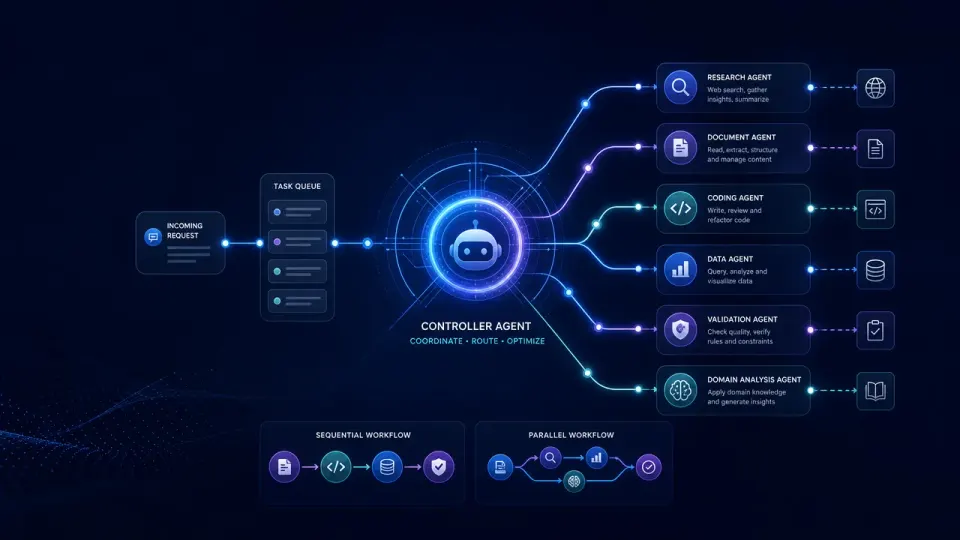
Table of Contents
Quick Answer
Multi-agent orchestration coordinates specialized agents, models, tools, data, and workflows to complete complex objectives. Use worker agents for bounded tasks, controller agents for planning and synthesis, parallel execution for independent work, and sequential flows when tasks depend on one another.
The right architecture depends on four questions:
- Are the subtasks independent or dependent?
- Does each require a different capability or tool?
- How costly would an incorrect or unauthorized action be?
- Must the work continue over hours, days, or scheduled events?
A single agent often suits a short, linear task. Worker agents help divide work into bounded specialties. A controller-worker design fits complex objectives requiring planning and synthesis. Persistent orchestration is justified when a workflow must resume or respond to events over time.
What Is Multi-Agent Orchestration?
For example, a procurement workflow could use one agent to extract requirements, several workers to compare approved suppliers, another to check contract terms, and a controller to produce a recommendation. Each agent should receive only the data and tools required for its assignment.
Multi-agent orchestration is therefore more than sending several prompts to several models. It involves task decomposition, communication, state management, error handling, and governance.
Adding a controller and three workers to these tasks can increase latency, token usage, and failure points without improving the result. If you cannot describe what each additional agent owns, the system may not need additional agents.
The Core Multi-Agent Patterns
Collect requirements -> Retrieve records -> Analyze options -> Draft result -> Review -> Deliver ```
This suits document processing in which pages must be identified before fields are extracted and fields validated against a database. Sequential workflows are easier to test and audit, but they waste capacity when independent steps could run simultaneously.
In a competitive analysis, workers could examine pricing, product features, customer reviews, and regulatory filings concurrently. A synthesis step would then compare their outputs using a common template.
Parallel execution requires clear output formats, shared definitions, source requirements, confidence fields, and an evaluation step. Ten workers can otherwise produce ten inconsistent interpretations. The system should also tolerate a missing or delayed worker and prevent workers from editing the same state simultaneously.
A product launch plan might require a research worker for market evidence, a finance worker for costs, a legal worker for claims requiring review, a writing worker for the plan, and a critic worker for testing assumptions. The controller resolves conflicts, requests missing evidence, and decides whether the output is ready for approval.
This design can make the controller a bottleneck or single point of failure. Give it delegation rules, output contracts, retry limits, and escalation paths. Do not expect it to infer every business policy from a vague instruction.
What Worker Agents and Controller Agents Actually Do
- Research workers: find and compare information within approved sources
- Document workers: extract fields, classify files, or detect missing content
- Coding workers: write tests, inspect code, or propose a sandboxed patch
- Data workers: query approved datasets and return structured metrics
- Domain workers: perform finance, legal, security, medical, or operational analysis within defined limits
- Validation workers: check outputs against rules, schemas, policies, or independent evidence
A good instruction defines the task, context, tools, output format, acceptance criteria, and prohibited actions. “Analyze this contract” is weak. “Identify renewal dates, termination rights, unusual liability terms, and missing signatures; return structured fields; do not contact the counterparty” is safer.
Clear boundaries also make workers replaceable. A research worker can be upgraded without redesigning the workflow if it returns the same contract and meets the same quality requirements.
- Break an objective into executable tasks
- Select the appropriate worker, model, or tool
- Pass only relevant context
- Track dependencies and completion status
- Compare results and resolve disagreements
- Request revisions or additional evidence
- Escalate high-risk decisions to a person
- Produce a result with provenance and limitations
Define success explicitly. A controller preparing a financial report might have to confirm that every number has a source, totals reconcile, and uncertain assumptions are labeled. Otherwise, it may optimize for a fluent report rather than a reliable one.
How to Decide Whether Parallel LLM Tasks Are Worth It
Objective: assess a potential acquisition - Worker A: analyze the target's financial statements - Worker B: review customer concentration - Worker C: examine security and compliance risks - Worker D: map competitors - Controller: reconcile findings and identify open questions ```
Each worker has a different evidence set and output. Parallelism can also improve resilience: if one worker fails, the controller can retry that branch without restarting the entire workflow. This requires task-level state and explicit partial-completion handling.
Editing one sensitive policy in parallel can create conflicting versions and unclear ownership. A sequential draft-review-approval process is safer. A hybrid approach is often best: perform dependent setup sequentially, run independent analysis in parallel, then return to sequential synthesis and approval.
The Tradeoffs of Multi-Agent Systems
Use structured messages rather than entire conversation histories. Include task IDs, source references, assumptions, confidence, status, and requested next actions. Add independent verification for decisions that matter.
Routing should consider complexity, accuracy, latency, privacy and data residency, tool-use reliability, and input and output cost. Set budgets per task, workflow, user, and time period. Also limit retries, tool calls, parallel branches, and maximum workflow duration.
Measure total cost per successful outcome, not only cost per model call. An unreliable low-cost worker may require expensive retries and human review.
Security and Permissions for AI Agent Coordination
Treat retrieved instructions and uploaded files as untrusted input because they may contain prompt injection or malicious commands. Use separate identities for agents where possible. A research worker should not inherit the ability to send email, modify production records, or approve payments. High-impact actions should require explicit authorization and, when appropriate, human confirmation.
Log permission decisions and tool calls so investigators can reconstruct events. Check authorization at action time, not only when the workflow begins.
Persistent and Scheduled Agents for Long-Running Workflows
Scheduled tasks might run a report every Monday morning, check a queue when records arrive, resume an approval after a human decision, or retry a failed integration after a defined interval. Long-lived access increases security and monitoring burdens, so give persistent agents an expiration date or review point.
Separate durable business state from temporary reasoning. Preserve facts, artifacts, and decisions while minimizing sensitive content, and define retention and deletion policies before deployment.
Monitoring Multi-Agent Workflows Before They Become Unsafe
Use correlation IDs across workers and structured outcomes such as success, retry, blocked, escalated, or failed. This shows whether errors began in planning, retrieval, tool use, synthesis, or permissions.
When a threshold is crossed, pause the workflow, revoke temporary credentials, preserve evidence, and route the case for review. Test prompt injection, a compromised worker, unavailable tools, conflicting outputs, expired permissions, and repeated controller retries. A system that works only on the happy path is not ready for production.
A Practical Decision Framework for Choosing an Architecture
Add a controller when work is open-ended, requires dynamic delegation, or combines specialties. Limit its authority and define escalation conditions.
Use persistent orchestration when work must survive interruptions, respond to schedules, monitor changes, or coordinate human approvals. Add checkpoints, expiration policies, durable state, and stronger monitoring.
Before building, map one real workflow. Mark tasks as single-agent, parallel, delegated, human-approved, or prohibited. Identify required data, systems, outputs, and failure responses. Often, only part of the workflow needs multi-agent orchestration.
Where Enterprise Multi-Agent Orchestration Is Heading
Enterprise AI agents are converging around specialized sub-agents, workplace and data integrations, model routing, persistent execution, scheduled triggers, and operational monitoring.
Enterprise platforms connect agents to Microsoft 365, Slack, Jira, Confluence, Git, BigQuery, Databricks, Postgres, and Snowflake. Model-routing providers match tasks to models and manage spending, while agent-monitoring vendors develop systems to identify unsafe behavior during execution.
Architecture decisions should begin with workflow requirements rather than a platform's feature list. The strongest system makes responsibilities clear, limits access, exposes failures, and delivers measurable value.
Conclusion
Multi-agent orchestration is useful when an objective contains distinct tasks, different capabilities, meaningful parallelism, or durable coordination. Use a single agent for straightforward work, workers for bounded specialties, controllers for decomposition and synthesis, and persistent workflows for long-running or scheduled operations.
Match the architecture to the work. Build around explicit contracts, least-privilege permissions, sandboxing, model and cost routing, checkpoints, observability, and human escalation. Map one workflow to the right orchestration pattern with a practical AI agent architecture checklist - identify the tasks to keep single-agent, parallelize, delegate, secure, and monitor before you build.
Step-by-Step Guide
Assess task dependencies and risk
Determine whether subtasks are independent, whether they require different capabilities, how costly errors would be, and whether the workflow must persist over time.
Choose the orchestration pattern
Select a single agent for simple work, sequential orchestration for dependent steps, parallel workers for independent analysis, or a controller-worker design for complex objectives.
Define worker contracts
Give each worker a narrow responsibility, approved context and tools, a structured output format, acceptance criteria, confidence fields, and explicit prohibited actions.
Configure coordination and state
Track task IDs, dependencies, status, source references, assumptions, outputs, retries, approvals, and errors so the workflow can tolerate partial failures and resume safely.
Apply controls and evaluate outcomes
Enforce least-privilege access, sandbox risky tools, set cost and duration limits, validate outputs independently, log tool calls, and route high-impact actions for human approval.
Key Statistics
- The article defines four architecture questions for choosing an orchestration approach.The supplied article uses task dependency, capability differences, error impact, and workflow duration as its decision framework.
- The article identifies six typical components of a multi-agent system.The supplied article lists the objective or trigger, orchestrator, worker agents, tools and systems, state and memory, and controls and monitoring.
- The article presents three primary execution patterns: sequential, parallel, and controller-worker orchestration.These patterns are described in the article as the core ways to coordinate dependent tasks, independent tasks, and complex objectives.
Frequently Asked Questions
What is multi-agent orchestration?
When should you use worker agents?
When should you use a controller agent?
When are parallel LLM tasks worthwhile?
How do you secure a multi-agent system?
Key Takeaways
- Use a single agent for short, linear, low-risk tasks that rely on one context or a small set of tools.
- Assign bounded, measurable responsibilities to worker agents and require structured outputs with acceptance criteria.
- Use controller-worker architectures for complex objectives requiring planning, routing, synthesis, exception handling, or escalation.
- Parallelize independent and separately verifiable tasks, but use sequential execution for dependent or shared-state operations.
- Protect orchestrated systems with least-privilege permissions, sandboxing, budgets, retries, monitoring, provenance, and human approval gates.