
Personal AI Agent Protocols: Trust for Agentic Commerce
Learn how a personal AI agent protocol enables safer agentic commerce through scoped permissions, approvals, identity, and audit trails.
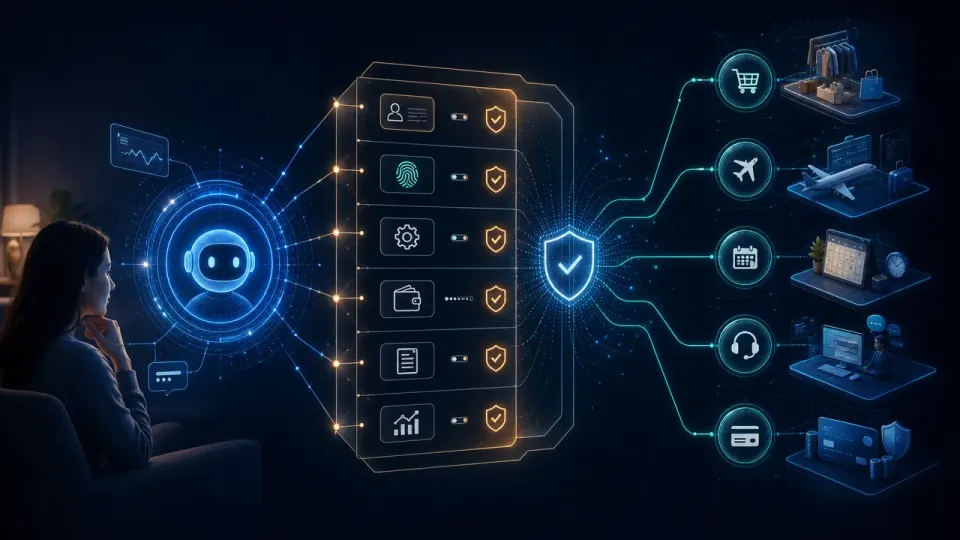
Table of Contents
Quick Answer
A personal AI agent protocol is a permission and accountability framework that lets an autonomous assistant interact with businesses on a user’s behalf. It defines identity, authorized actions, spending limits, approval requirements, transaction records, and revocation so agents can complete tasks without receiving unrestricted access.
A personal AI agent protocol is an emerging standard for that relationship. It could define how a consumer authorizes an agent, how a business declares what the agent may do, how transactions are approved, and how every action is recorded and attributed.
The central idea is simple: consumers control their agents, businesses control their systems, and the protocol creates a trusted boundary between them.
What is a personal AI agent protocol?
A personal AI agent protocol is a proposed technical and governance framework for communication between a person’s AI agent and a company’s digital systems or business-owned agent.
Instead of allowing an autonomous assistant to behave like an unrestricted browser user, the protocol would let the two sides exchange structured information such as:
- The agent’s identity and the user it represents
- Available business services and actions
- Permitted data access
- Spending, timing, and quantity limits
- Required approvals and authentication steps
- Transaction status, receipts, and audit records
It is best understood as a permission and accountability layer for agentic commerce , not merely a connection between an AI model and an API.
The consumer decides whether an agent may act, which accounts it can access, what information it can use, and when it must ask for confirmation. A user might permit an agent to find flights and prepare an itinerary but require approval before purchasing a ticket.
The business decides which capabilities it exposes. It might allow an agent to search inventory and check delivery dates but prohibit it from changing an address, issuing a refund, or accessing another customer’s information.
The agent can act only where those permissions overlap. A user cannot authorize an action a business does not support, and a business should not receive broader authority than the consumer granted.
A normal login does not show whether an action was deliberately approved by a person, automatically initiated by an agent, or triggered by malicious instructions. Businesses also need to distinguish legitimate agents from scraping bots, credential thieves, and systems attempting to overload a service.
A common protocol could let businesses recognize authorized agents, expose clearly defined capabilities, and enforce limits before an action reaches a sensitive system.
Why businesses need a standard way to work with personal AI agents
A user might say:
“Find a laptop under $1,200 with at least 16 GB of memory, free delivery by Friday, and a two-year warranty. Ask me before buying.”
The agent would need to search several merchants, interpret product data, compare terms, and present an approved option. These workflows require identity, authorization, payments, customer records, business rules, and accountability.
An authorized personal agent is not simply a human customer, but it is not an anonymous bot. It represents a specific person under specific instructions. A protocol can express that distinction by showing which customer the agent represents, what it may do, and whether the customer approved the transaction.
How the consumer-business permission model works
- Search public products and prices
- Read order status for one account
- Schedule appointments within specified hours
- Use a selected payment method up to a fixed amount
- Contact customer service about a named order
The user could separately require confirmation for purchases above a threshold, recurring subscriptions, changes to shipping or billing details, access to health, financial, or identity information, and cancellations, legal agreements, or account deletion.
Permissions should expire. A travel agent authorized for one trip should not retain indefinite access to every future booking.
A retailer could expose product search, inventory, delivery estimates, checkout, order tracking, and returns as separate capabilities. It could require stronger authentication for checkout and prohibit agents from combining customer records across accounts.
Rules may include geographic or account restrictions, rate limits, fraud checks, approval requirements for regulated products, restrictions on bulk purchasing or resale, and conditions for refunds, exchanges, and cancellations.
How agent-to-agent commerce could work
For example, it could look for a hotel room that meets a budget, cancellation policy, location, and accessibility requirement. Structured offers and constraints would reduce the need to imitate every human click.
The personal agent represents the customer’s interests; the business agent represents the company’s systems and policies. They could negotiate details within fixed limits. A personal agent might request delivery by Thursday, while the business agent offers two eligible windows and the applicable fee. Neither should invent terms outside its authority.
An approval screen should identify the merchant, items, total cost, recurring charges, delivery details, and refund conditions. Users may choose standing authorization for low-risk, repeatable actions, but explicit confirmation should remain the default for expensive, irreversible, or sensitive actions.
Who is developing the emerging standard?
Participation by businesses and payment providers will be important. A protocol used only by agent developers cannot solve the access problem. Merchants, software platforms, identity providers, and financial systems must recognize the same concepts of authorization and accountability.
The effort remains an emerging standard, not a universally adopted final specification. Names, message formats, identity systems, and enforcement rules may change as organizations test the model.
Personal AI agent protocol vs. Model Context Protocol
- Whose authority the agent represents
- What the consumer approved
- Which actions the business permits
- Who must confirm the transaction
- How disputes and refunds are handled
- What records prove what happened
MCP alone does not answer those questions. A tool connection can be technically valid while being too broad, poorly authenticated, or unsafe for a consumer transaction.
In simple terms, MCP may help an agent call a tool; the business-facing protocol should determine whether it is allowed to call that tool, for which user, under what conditions, and with what approval.
The security requirements for trustworthy agent interactions
Permissions should be scoped by user, business, account, action, data type, amount, and duration. An identity token for one merchant should not automatically work across unrelated services. Businesses need evidence that the user granted permission, while consumers need a way to inspect and revoke it.
Consumers should be able to review activity in plain language, such as “Agent accessed order history” or “Agent attempted a $640 purchase, awaiting approval.” Revocation must take effect quickly and invalidate active access, not merely hide it from the interface.
This risk is often called prompt injection, but it also includes unsafe handling of secrets, untrusted tool outputs, and confused-deputy attacks. Defenses should include:
- Separating trusted policies from untrusted content
- Validating tool inputs and outputs
- Preventing one business from silently redirecting an agent to another service
- Filtering sensitive data before it leaves a permitted context
- Requiring fresh confirmation for unexpected or high-impact actions
- Testing agents against prompt injection and confused-deputy attacks
Reported attacks involving agent tools show why a protocol cannot rely on model judgment alone. Technical permissions and independent policy enforcement must constrain what an agent can do.
Identity and accountability in agentic commerce
One approach is to give a business agent its own account, email address, and organizational context, with limited privileges and company monitoring. This should not mean unrestricted employee accounts. Agent identities should be machine-readable, scoped, and easy to disable.
That chain supports fraud investigations, customer support, compliance reviews, and billing disputes.
Identity and logs help answer these questions, but they do not establish liability by themselves. Contracts, consumer-protection law, payment rules, and merchant policies will still matter.
What the protocol means for consumers and businesses
- Grant only the permissions needed for the task
- Set spending, product, merchant, and time limits
- Require confirmation for purchases, subscriptions, and account changes
- Use a tokenized or limited payment method when available
- Restrict access to sensitive personal data
- Review activity logs and receipts
- Revoke access when the task or relationship ends
- Keep alerts enabled for failed, unusual, or high-value actions
If you would not give a temporary human assistant unrestricted access, do not give it to an AI agent.
Teams should document supported agent identities and authentication methods, available actions and required data, consent requirements, spending and rate limits, human escalation paths, logging and retention rules, revocation and incident-response procedures, and responsibility for failed or disputed actions.
A controlled business agent may be safer than allowing external agents to navigate an ordinary website because it gives the company a defined surface to monitor and update.
What to watch as the personal AI agent protocol develops
A personal AI agent protocol could become the trust layer that makes agentic commerce practical. Its success will depend less on how naturally agents converse than on whether every action is limited, attributable, reviewable, and reversible when possible.
Businesses preparing for agentic commerce should begin by reviewing which actions, data, and payment workflows they could safely expose to authorized AI agents. Define approval, identity, logging, and revocation requirements before enabling access.
Step-by-Step Guide
Define the agent’s authority
Specify which user, account, business, data types, actions, spending limits, and time periods the personal agent may access.
Expose business capabilities
Separate business functions such as search, inventory, checkout, order tracking, returns, and support, and assign explicit rules to each capability.
Exchange scoped identities and permissions
Use verifiable identity and authorization records to show whom the agent represents, what the user approved, and which business actions are allowed.
Require approval for consequential actions
Present the merchant, items, total cost, recurring charges, delivery details, payment method, and cancellation terms before completing sensitive or irreversible actions.
Record, monitor, and revoke activity
Create an audit trail for requests, approvals, policy decisions, and results, and provide consumers with a fast way to inspect and invalidate access.
Key Statistics
- Eight organizations are identified as participants in reported development efforts: Meta, Sierra, Genesys, Instinct, Rocket, Shopify, Stripe, and Walmart.Counted from the organizations named in the article’s section on emerging standard development; the article characterizes the effort as evolving rather than universally adopted.
- Three action-oriented personal-agent examples are cited: Meta’s Muse, Instinct, and ChatGPT’s Dots.The article presents these examples as evidence that personal agents are moving beyond text generation toward task completion; product names and capabilities may change as the ecosystem develops.
- Six permission dimensions are explicitly recommended for scoping agent access: user, business, action, data type, amount, and duration.This six-part model is synthesized from the article’s security guidance on least-privilege permissions and provides a practical structure for authorization design.
- The article distinguishes two protocol layers: tool connectivity through MCP and consumer-business governance through a personal AI agent protocol.This two-layer comparison is the article’s conceptual model: MCP can support tool calls, while the broader protocol should govern authority, approval, policy, and accountability.
Frequently Asked Questions
What is a personal AI agent protocol?
How does a personal AI agent protocol protect consumers?
How is a personal AI agent protocol different from MCP?
Why do businesses need protocols for autonomous AI agents?
When should an AI agent ask for user approval?
Key Takeaways
- Personal AI agent protocols create a trusted boundary between consumer-controlled agents and business-controlled systems.
- Consumers should control identity, data access, spending limits, approvals, and permission duration.
- Businesses should expose narrowly defined capabilities with authentication, rate limits, fraud controls, and policy restrictions.
- MCP can connect an agent to tools and data, but it does not by itself define consumer authority, transaction consent, or dispute handling.
- High-impact actions require clear approval screens, audit logs, rapid revocation, and defenses against prompt injection and data exfiltration.