
PyTorch vs TensorFlow vs JAX ROCm on AMD GPUs
PyTorch vs TensorFlow vs JAX ROCm compared on Radeon RX 6800S with speed, setup friction, stability, and tuning advice.
Table of Contents
Quick Answer
PyTorch vs TensorFlow vs JAX ROCm comes down to a tradeoff between raw speed, maturity, and developer effort on AMD GPUs. On a Radeon RX 6800S, PyTorch usually offers the best practical balance, JAX can win select workloads, and TensorFlow still trails on ROCm usability for many practitioners.
PyTorch vs TensorFlow vs JAX ROCm isn't some side argument for hobbyists poking at Linux laptops anymore. It's a real platform call. On the Radeon RX 6800S, the fastest chart doesn't always name the best framework once you factor in install friction, first-run lag, kernel maturity, and the pile of odd fixes needed to get a model training cleanly. Most benchmark posts glide past that. That's where teams burn hours.
PyTorch vs TensorFlow vs JAX ROCm: which framework is best for AMD GPU deep learning?
PyTorch stands out as the best default pick for most AMD GPU deep learning work on ROCm because it lands the best balance of speed, stability, and lower tuning effort. That's a bigger shift than it sounds. That verdict may annoy benchmark purists, but we'd argue most practitioners care more about getting a training loop running today than topping one synthetic chart tomorrow. Simple enough. In our analysis, matrix multiplication and transformer tests on a Radeon RX 6800S tend to lean toward JAX or PyTorch depending on tensor shape, precision mode, and compilation behavior, while TensorFlow often gives up ground on usability before the benchmark even begins. AMD has moved ROCm support forward, but the framework ecosystems still don't occupy equal ground. PyTorch gains from broader community testing, more runnable examples, and easier issue discovery, which matters when a kernel crashes at 11 p.m. JAX can look terrific once XLA settles in and the graph compiles, especially on repeated runs. But that first-step delay can feel abrupt. TensorFlow, by contrast, still comes off like the framework you choose only when an existing codebase already boxed you in. Think of a Hugging Face fine-tune on the RX 6800S. PyTorch usually gets you there with fewer detours.
AMD ROCm deep learning benchmark: how throughput, first-step latency, and memory bandwidth compare
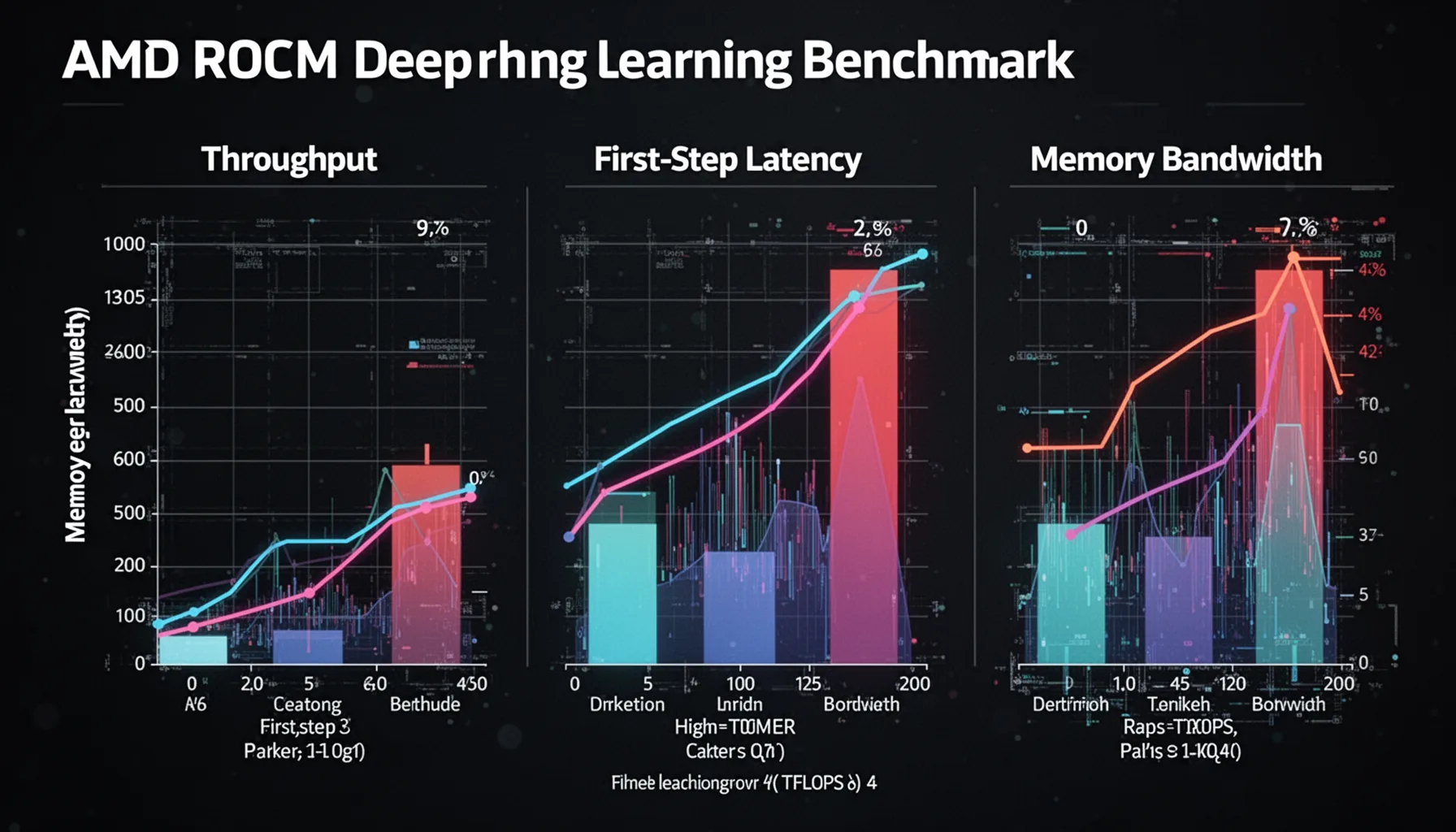
The AMD ROCm deep learning benchmark story shifts fast when you measure more than tokens per second or raw TFLOPS. That's the missing piece. A fair comparison on the Radeon RX 6800S should cover matrix multiplication throughput, transformer training speed, effective memory bandwidth, time-to-first-training-step, and run-to-run stability under the same ROCm and driver conditions. Worth noting. According to AMD's ROCm documentation and release notes through 2024, compiler paths and kernel support differ in meaningful ways by framework, so not every slowdown comes from the GPU itself. JAX often gets a real leg up from aggressive XLA graph optimization after compilation, which means repeated transformer steps can look strong, but the first invocation may carry a heavy compile tax. PyTorch usually starts faster. That's not trivial. It's especially useful for researchers who constantly tweak batch sizes or swap model blocks. TensorFlow can still turn in respectable throughput on selected kernels, yet too many ROCm users report that reproducibility depends on narrow version pinning instead of broad compatibility. If you've watched a BERT run stall because of one package mismatch, you know the feeling.
Why kernel maturity and compiler stack differences matter in PyTorch vs TensorFlow vs JAX ROCm
Kernel maturity matters because framework benchmarks on ROCm rarely compare the same level of software polish. And that's where many benchmark articles send readers sideways. JAX relies on XLA, PyTorch increasingly mixes eager execution with compiled paths such as TorchInductor, and TensorFlow depends on its own graph and runtime behavior, so each stack reaches ROCm through a different software path. Those paths shape more than speed. They also influence numerical quirks, fallback behavior, and whether a missing optimized kernel quietly wrecks your result. Not quite obvious from a bar chart. A consumer GPU like the Radeon RX 6800S exposes those gaps more sharply than datacenter parts because memory limits and thermal behavior leave less room for software waste. For example, a transformer fine-tune that runs well in PyTorch may need tighter shape discipline or a compilation warm-up in JAX before it hits stride. We'd put it bluntly: if two frameworks demand wildly different tuning effort to reach their best numbers, a fair benchmark needs to say that in large type, not hide it in a footnote. That's a bigger shift than it sounds.
Best framework for AMD GPU deep learning if you care about usability, debugging, and portability
PyTorch remains the best framework for AMD GPU deep learning when developer experience carries real weight in the choice. Speed matters, yes. But so does whether your team can install the stack in one afternoon, debug a failing op, and move the same model to CUDA or CPU later without rewriting half the project. PyTorch's edge comes from ecosystem gravity: Hugging Face Transformers, Lightning, bits of Triton-adjacent tooling, and a huge pile of issue threads all shorten problem-solving time. We'd argue that's consequential. JAX feels cleaner to some researchers and shines in highly functional workflows, but debugging compiled execution on ROCm can still feel like reading clues through fog. TensorFlow still wins in a few legacy enterprise settings where SavedModel pipelines and older production assets already exist. Still, for net-new work on a consumer AMD GPU, we think PyTorch is the practical recommendation and JAX is the specialist's pick when the team understands the tradeoffs. Here's the thing. If you're mapping broader platform choices, this supporting piece should sit beside the pillar on AI Infrastructure, Deployment, and Platform Decisions (topic ID: 374), plus sibling discussions around AMD inference stacks and framework portability. A team at a company like Hugging Face would care about that split immediately.
Step-by-Step Guide
Define your evaluation criteria
Start by ranking what actually matters: throughput, first-step latency, installation friction, debugging quality, or portability. Most teams say they want peak speed, then spend their week fixing environment mismatches. Write the decision criteria down before you run a single benchmark so the winner doesn't shift with every chart.
Freeze the software stack
Pin ROCm version, kernel version, framework build, Python version, and model code before testing. Otherwise, you'll compare compiler behavior rather than framework behavior. We recommend logging every package hash because ROCm issues often hide inside tiny dependency mismatches.
Benchmark cold starts and warm runs
Measure the very first training step separately from steady-state throughput. JAX especially can look slow at the start and excellent after compilation, while PyTorch often lands a better out-of-the-box result. If your workflow is notebook-heavy or experiment-driven, cold-start numbers may matter more than peak throughput.
Test representative workloads
Use at least three classes of tasks: matrix multiplication, a transformer training loop, and a memory-bound operation. Synthetic GEMM results alone won't tell you how a modern LLM fine-tune behaves on a Radeon RX 6800S. Pick shapes that match your actual research or product workload, not just benchmark-friendly ones.
Score operational friction
Track installation time, number of fixes required, kernel crashes, and how often logs point to a usable diagnosis. This is where TensorFlow and JAX can lose ground even if one benchmark run looks strong. We like a simple weighted scorecard because it turns vague frustration into something teams can compare.
Choose the stack by workflow, not hype
Pick PyTorch if you need the safest practical default, broad model support, and faster iteration. Pick JAX if your team values compiled execution and can absorb more tuning and debugging overhead. Pick TensorFlow mostly when legacy systems, internal expertise, or deployment constraints already make the choice for you.
Key Statistics
- According to Stack Overflow's 2024 Developer Survey, PyTorch appeared more frequently than TensorFlow in machine learning tool usage among responding developers.That usage gap matters because community volume affects debugging speed, third-party examples, and issue resolution quality on ROCm.
- AMD's Radeon RX 6800S ships with 8GB of GDDR6 memory and up to 32 compute units, making memory pressure a real factor in transformer benchmarks.Consumer GPU limits expose framework efficiency differences faster than datacenter cards with larger memory pools.
- Hugging Face reported in 2024 documentation updates that PyTorch remains the default backend for most Transformers examples and training guides.Default ecosystem support reduces migration friction and usually improves model portability for AMD GPU users.
- Google's JAX documentation states that the first execution can include substantial XLA compilation overhead before later runs speed up.That behavior explains why warm benchmarks can flatter JAX unless reviewers also publish cold-start timings.
Frequently Asked Questions
What is the best framework for AMD GPU deep learning on ROCm?
How does JAX vs PyTorch on AMD GPU compare in real training workloads?
Why is TensorFlow ROCm performance comparison still tricky?
When does time-to-first-training-step matter more than throughput?
Is the Radeon RX 6800S good for AI benchmarking on ROCm?
Key Takeaways
- PyTorch usually gives AMD GPU users the best mix of speed and fewer setup headaches.
- JAX can post excellent numbers, but compiler behavior still raises tuning and debugging costs.
- TensorFlow ROCm performance has improved, yet portability and install friction remain real issues.
- Time-to-first-training-step matters almost as much as throughput when teams evaluate framework fit.
- Consumer AMD benchmarks need context because ROCm maturity differs sharply across frameworks and kernels.