
Cloud vs self hosted AI: practical enterprise guide for 2026
Cloud vs self hosted AI explained with costs, security, latency, and deployment tradeoffs for smarter enterprise AI decisions in 2026.

Table of Contents
Quick Answer
Cloud vs self hosted AI comes down to speed and flexibility versus control and long-term efficiency. Most enterprises should start in the cloud, then move select workloads to self-hosted infrastructure when scale, privacy, latency, or unit economics justify it.
Cloud vs self hosted AI sounds like a tidy architecture call. It isn't. For plenty of teams, it's really a finance, security, operations, and product choice packed into one monthly bill. And that bill keeps rising. Average enterprise AI spending hit $85,500 per month in 2025, up 36% year over year. So if your team still treats this as cloud equals easy and self-hosted equals hard, you're probably skipping the pricey part of the story.
What does cloud vs self hosted AI actually mean for enterprise teams?
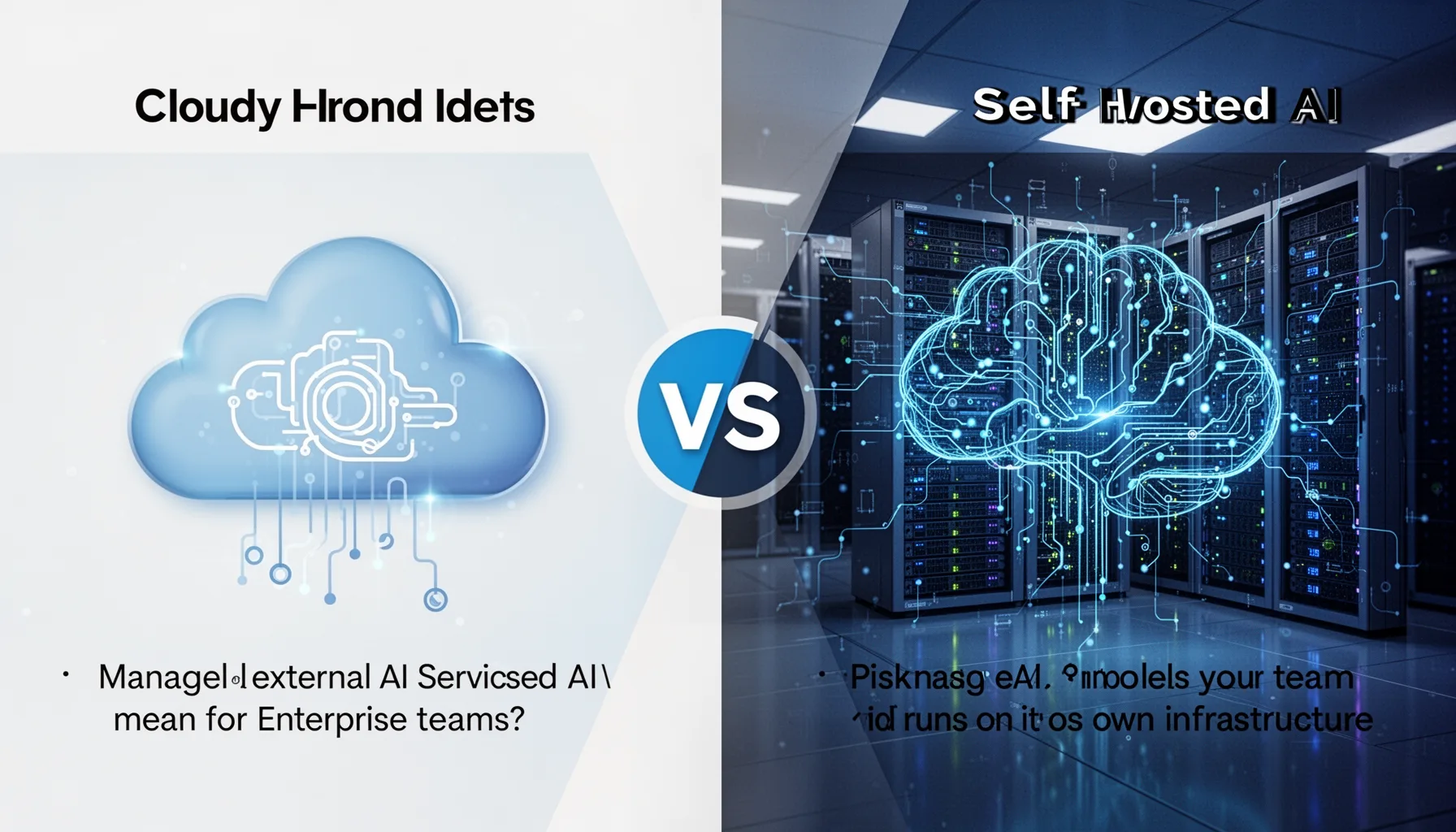
Cloud vs self hosted AI means picking between managed external AI services and models your team runs on its own infrastructure. Simple enough. That's the plain-English version, and it matters because teams often compare tools when they should compare operating models. In cloud AI for enterprise vs on premise AI setups, vendors such as Microsoft Azure OpenAI Service, Amazon Bedrock, and Google Vertex AI run model serving, scaling, and a good share of the security plumbing. Self-hosted setups hand that work to your team, whether you run open models like Llama 3, Mistral, or Qwen on your own GPUs, colocated racks, or providers such as CoreWeave. Those are very different commitments. We'd argue most enterprises underrate the people cost of self-hosting, especially around observability, patching, and model lifecycle management. Worth noting. A bank building internal summarization tools may pick self-hosting for data governance, while a retail brand launching a support bot often reaches market faster with cloud APIs.
How does the self hosted AI vs cloud cost comparison change at scale?
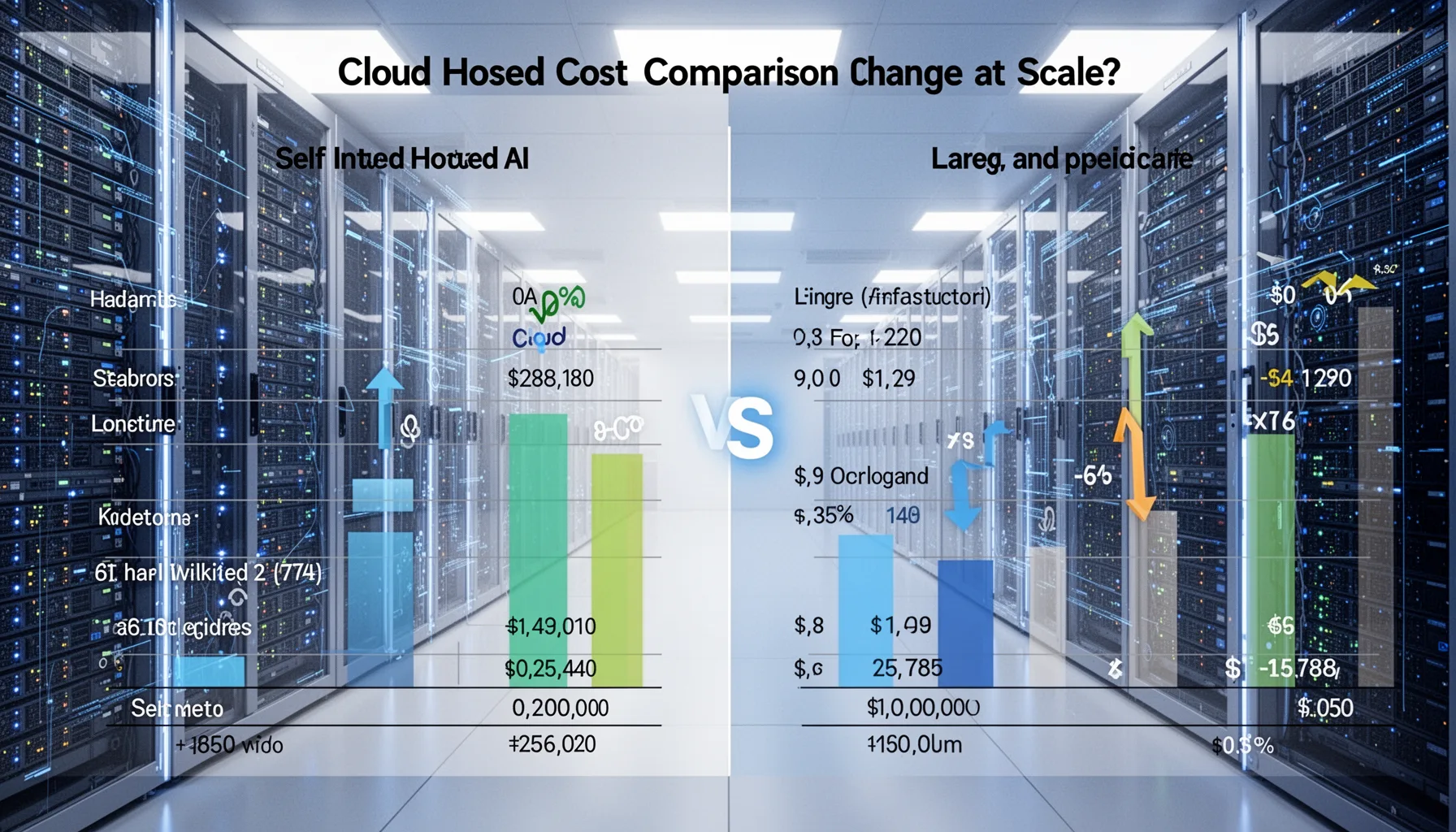
The self hosted AI vs cloud cost comparison shifts when workloads turn steady, large, and predictable. Here's the thing. Cloud pricing feels cheap during the pilot stage because you skip capital expense and pay only for usage, but that math can flip once inference volume climbs month after month. According to Menlo Ventures' 2024 enterprise AI report, organizations sharply raised production AI budgets as more pilots moved into customer-facing use. That trend hasn't cooled. If you process millions of tokens, images, or audio streams each day, API markups and premium managed services can outrun the cost of owning or leasing dedicated GPU capacity. But self-hosted isn't automatically cheaper. Procurement, MLOps staffing, redundancy, and downtime risk all land on the ledger. Consider Adobe Firefly-style media workloads or a contact center analyzing every call: at enough volume, reserved infrastructure can beat public API spend, but only if utilization stays high. That's a bigger shift than it sounds. My view is blunt: most CFOs ask the wrong cost question when they stare at list price instead of total cost per reliable output.
When to self host AI models instead of using cloud AI for enterprise
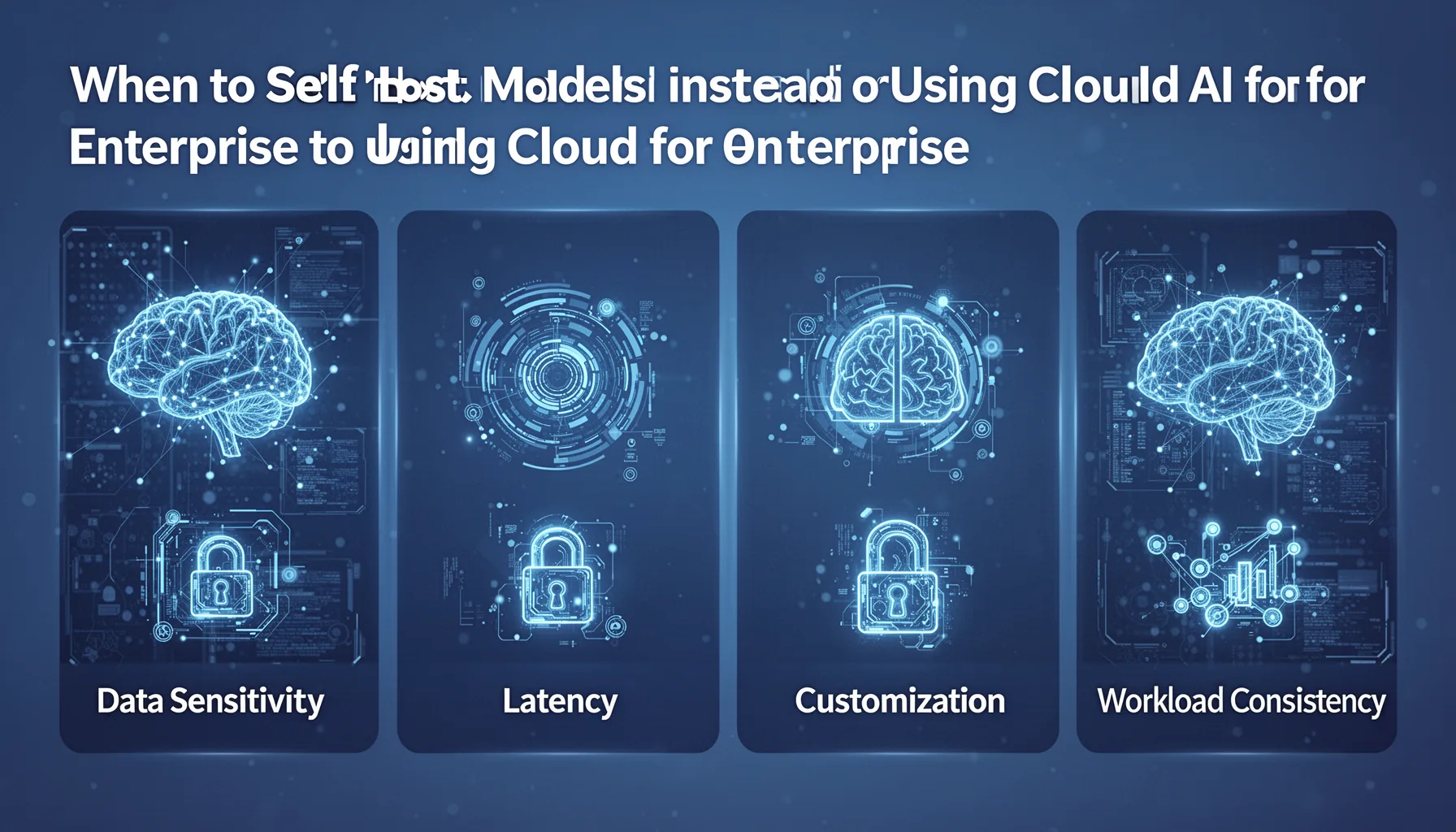
When to self host AI models usually comes down to four triggers: data sensitivity, latency, customization, and workload consistency. Not quite a simple checklist. If your company handles regulated customer records, proprietary code, or internal research, keeping models near the data may cut legal and security headaches. That's why firms in healthcare and finance often test on-prem or virtual private deployments first. Latency matters too. A factory vision system or in-store recommendation engine can't always wait on a distant API round trip. Self-hosting also gives teams deeper control over fine-tuning, model routing, quantization, and hardware optimization with stacks like vLLM, TensorRT-LLM, or Kubernetes with KServe. We'd still caution against self-hosting just because it feels intellectually satisfying; control is nice, but it can turn into an expensive hobby if the use case doesn't justify it. Worth noting. Think of a hospital imaging workflow: if every millisecond and every record matters, the trade-off looks very different.
Why cloud vs self hosted AI gets trickier for multimodal emotion AI
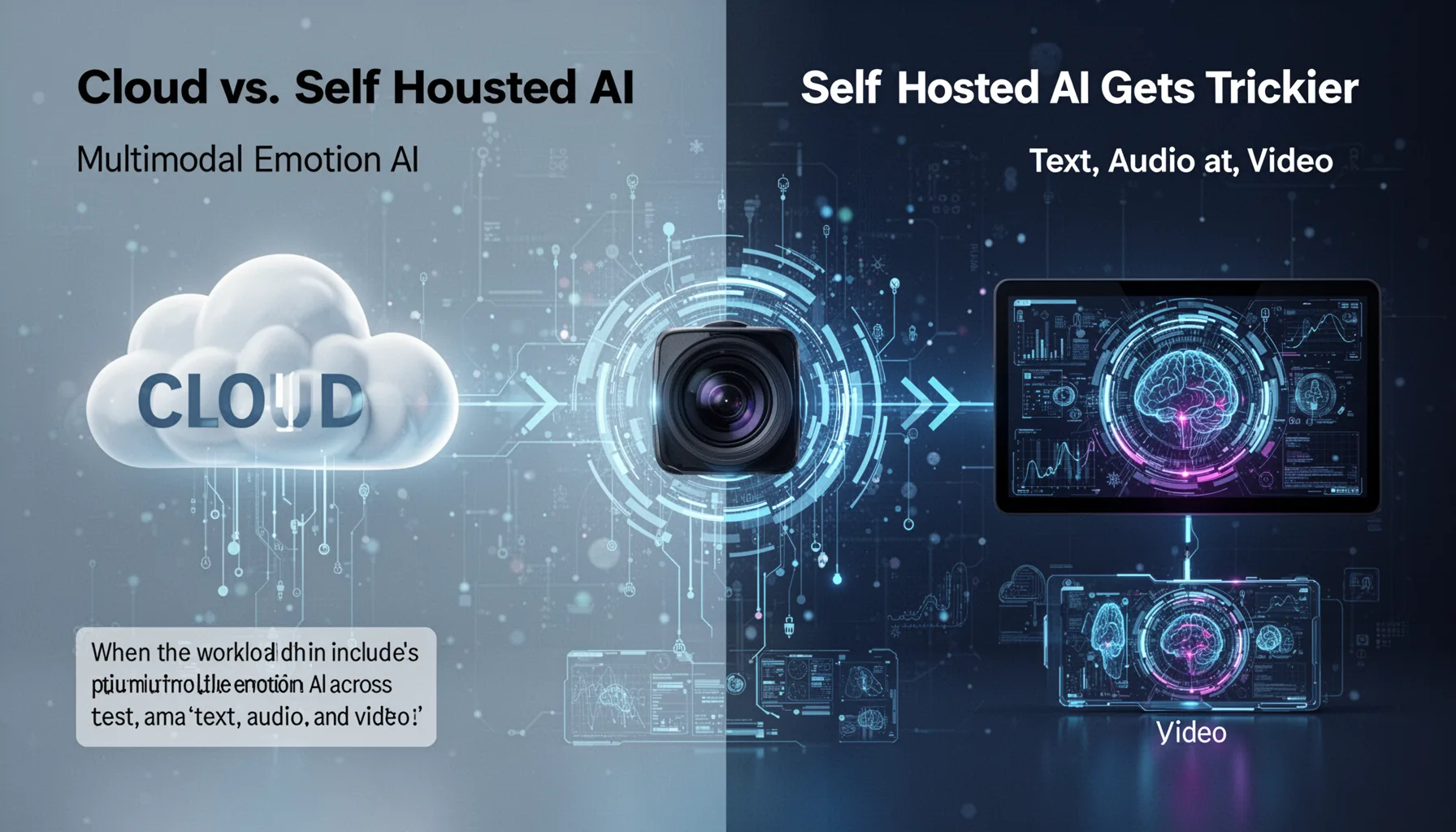
Cloud vs self hosted AI gets trickier fast when the workload includes multimodal emotion AI across text, audio, and video. That's where theory collides with production. Advanced fusion methods, including graph convolutional network approaches in multimodal emotion recognition in conversation, can capture speaker relationships and cross-turn context better than simpler late-fusion pipelines. That matters on paper. A transformer-only baseline may encode each modality well, but fusion-aware graph structure can model who spoke when, emotional carryover across turns, and interaction patterns that plain concatenation often misses. In benchmarks such as IEMOCAP, MELD, and CMU-MOSEI, researchers have repeatedly shown that structured multimodal methods can improve classification accuracy over unimodal or naive fusion baselines. But production is cruel. In a contact center, microphones clip, webcams stay off, speakers interrupt each other, and privacy teams may ban facial analysis entirely, which breaks the tidy assumptions many MERC papers rely on. We'd argue self-hosted deployments often make more sense here because streaming audio-video inference, data residency, and custom latency tuning matter, yet many teams should avoid full emotion AI rollouts until they've tested missing-modality behavior, bias across speaker turns, and whether simpler text-plus-acoustic features already solve the business problem. That's a bigger shift than it sounds. Think of a Zoom-style support workflow: benchmark wins don't mean much if half the cameras are dark.
What is the best AI infrastructure choice for business in 2026?

The best AI infrastructure choice for business in 2026 is usually a hybrid architecture, not a purity test. Most enterprises should keep experimentation, burst capacity, and third-party foundation model access in the cloud while moving high-volume or sensitive workloads into dedicated environments. That's already how mature teams operate. Gartner said in its 2025 infrastructure guidance that enterprises increasingly rely on mixed deployment patterns for AI to balance governance, cost, and speed. A practical example is a meeting analytics vendor that uses a cloud LLM for summarization but self-hosts speech diarization and embeddings to control cost and protect customer recordings. We'd connect this topic to supporting decisions around model serving economics, observability, and compliance workflows, including deeper guides like topic IDs 361, 364, and 371. Here's the thing: if you're looking for an enterprise AI deployment guide 2026, start with the workload, not the ideology, because architecture should follow risk, economics, and user experience. Worth noting.
Step-by-Step Guide
Audit your workloads
List every AI use case by modality, traffic pattern, latency need, and data sensitivity. Separate internal copilots from customer-facing systems and from batch analytics. This step prevents teams from making one infrastructure choice for five very different problems.
Model the full cost curve
Compare cloud API pricing, reserved instances, GPU leases, staffing, support, storage, and downtime exposure. Run scenarios for pilot, six-month growth, and steady-state production. The right answer often changes once utilization becomes predictable.
Classify your compliance risk
Map each workload to regulatory and contractual requirements such as HIPAA, GDPR, SOC 2 controls, or customer data residency terms. Some use cases can stay in public cloud with the right controls, while others probably can't. Legal and security teams should weigh in early, not after procurement.
Benchmark latency and quality
Test cloud and self-hosted options against the same prompts, media inputs, and service-level targets. Include failure cases like noisy audio, missing video, and context-window overflow. For multimodal emotion systems, this is where many pretty demos fall apart.
Design a hybrid fallback path
Plan for model outages, cost spikes, vendor changes, and missing modalities before launch. You might route premium workloads to a managed cloud model and keep a local open-weight fallback for continuity. Resilience matters more than architectural purity.
Review the decision quarterly
Revisit the choice as model prices, open-source quality, and hardware availability shift. What looked expensive to self-host in Q1 may look sensible by Q4. And the reverse happens too when managed vendors cut pricing or add needed controls.
Key Statistics
- Enterprise AI spending averaged $85,500 per month in 2025, up 36% from the prior year.That budget growth makes infrastructure choices materially more expensive, especially when teams lock into the wrong deployment pattern.
- According to McKinsey's 2025 State of AI survey, 78% of organizations reported using AI in at least one business function.Broad adoption means cloud and self-hosted decisions now affect mainstream IT planning, not just experimental R&D teams.
- Gartner projected in 2025 that more than 50% of generative AI deployments would use domain-specific or hybrid models by 2027.That points toward mixed architectures where cloud access and self-hosted control coexist.
- Research benchmarks on datasets such as IEMOCAP, MELD, and CMU-MOSEI often report multimodal models outperforming unimodal baselines by several F1 or accuracy points.Those gains are real in controlled settings, but they don't guarantee reliable production performance when modalities go missing or privacy rules restrict collection.
Frequently Asked Questions
What is the difference between cloud AI and self hosted AI?
How do I decide between cloud vs self hosted AI for my company?
When should an enterprise self host AI models?
Is self hosted AI cheaper than cloud AI?
Why is multimodal emotion AI hard to deploy in production?
Key Takeaways
- Cloud wins when teams need fast launches, managed services, and low upfront operational overhead.
- Self-hosted AI makes sense when usage is heavy, data is sensitive, or latency targets are strict.
- The self hosted AI vs cloud cost comparison changes quickly once inference volumes become predictable.
- Multimodal systems, especially emotion AI, often look strong in benchmarks and messy in production.
- The best AI infrastructure choice for business is usually hybrid, not ideological or one-size-fits-all.