
Why do people hate artificial intelligence? A clearer answer
Why do people hate artificial intelligence? We break down job fears, privacy concerns, bad AI products, and how to talk to skeptics well.

Table of Contents
Quick Answer
Why do people hate artificial intelligence? Most people don't hate AI in the abstract; they react to job anxiety, privacy fears, unfair economics, bad product design, and companies pushing AI where it doesn't belong.
Why do people hate artificial intelligence? That's the wrong first question. And also, weirdly, the right one. What people label anti-AI sentiment usually bundles together several complaints: fear of replacement, anger over data practices, fatigue with lousy products, and irritation with companies acting like every app suddenly needs a chatbot. Some objections come from principle. Others grow out of everyday friction that executives too often mistake for panic. If we mash all of that into one vague backlash, we miss what the AI backlash explained actually looks like in real life. Worth noting.
Why do people hate artificial intelligence, or do they hate how it’s being deployed?

Most people who say they hate AI aren't reacting to the technology in the abstract. They're reacting to how companies roll it out. That's the consequential distinction. When users run into spammy summaries, forced copilots, broken search results, or customer support loops that lock them inside automation, AI doesn't feel like a useful tool. It feels like a downgrade. Simple enough. And once that impression lands, every new launch inherits the suspicion. We'd argue the tech industry earned a lot of this by shipping AI before it proved itself in ordinary, daily settings. Think Google search complaints. Think Microsoft Copilot confusing office workflows. Think social platforms stuffing feeds with synthetic content nobody asked for. Those aren't edge cases. They're the product layer of the AI backlash explained, and they matter because bad UX turns mild skepticism into active dislike. That's a bigger shift than it sounds.
Why is AI seen as replacement instead of tool at work?
AI gets framed as replacement instead of tool when managers lead with headcount talk and only later mention productivity. So employees hear threat before they hear benefit. Public fear of AI job replacement isn't just emotional residue from science fiction; it follows real corporate language about efficiency, automation, and doing more with fewer people. That part isn't mysterious. When firms announce layoffs while praising generative AI in the same quarter, workers connect the dots even when executives insist those stories don't overlap. We'd argue workers are often reading the situation plainly. A screenwriter, a junior marketer, or a customer support agent doesn't need a seminar in philosophy to feel the squeeze when tasks once treated as skilled work turn into cheap drafts from a model. Not quite abstract. Klarna's comments about AI-driven customer service became a flashpoint because they fed the exact story workers already feared: AI won't merely assist, it may shrink labor demand. Worth watching.
Why are creators and students against generative AI?
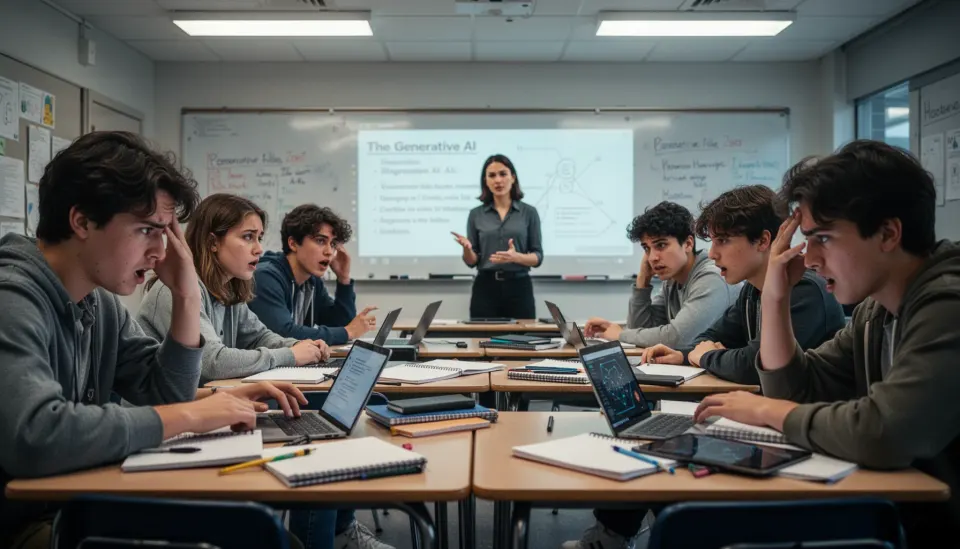
Creators and students push back on generative AI for different reasons, but both groups care a lot about authorship, fairness, and trust. That's where the heat really sits. Many artists, writers, voice actors, and photographers object because the economics feel upside down: AI companies chase low prices for users while training on huge reserves of human work that often brought little direct compensation to the people who made it. Students, meanwhile, face a stranger bind. They see AI as both shortcut and surveillance trigger, with schools tightening rules, teachers doubting authentic work, and learning itself getting pinched between convenience and suspicion. Here's the thing. We don't see these reactions as anti-progress tantrums. They're conflicts over status and identity, shaped by poor governance. Getty Images suing Stability AI, and universities rewriting integrity rules around ChatGPT, point to how fast generative tools can move from handy helper to cultural threat when rights and norms trail adoption. That's not trivial.
How bad pricing, privacy worries, and forced AI features fuel AI backlash explained
AI backlash explained often comes back to a basic mismatch between what people are asked to surrender and what they receive in return. That's true for money, data, and control. Users want cheap tools, yes, but they also want creators paid fairly, personal information protected, and products that don't quietly turn them into beta testers. Those expectations are normal. Not contradictory. We think a lot of public anger comes from companies pretending they can offer bargain AI, swallow giant compute costs, ingest broad internet data, and still dodge hard choices around rights and transparency. Meta's reliance on public content for model development, Adobe's repeated clarifications about how customer work gets handled, and Zoom's 2023 policy backlash all made clear how quickly trust evaporates when terms around data feel slippery. And when companies bolt AI onto products that already worked perfectly well, they create a fresh kind of resentment: people don't like being volunteered into somebody else's product strategy. Worth noting.
How to talk to skeptics about AI without sounding like a pitch deck
How to talk to skeptics about AI starts by separating valid criticism from blanket rejection. That's non-negotiable. If someone worries about job loss, don't answer with airy talk about productivity; ask which tasks may be deskilled, who captures the savings, and what protections would make adoption feel fair. If a creator worries about training data, don't brush it aside as inevitable progress; talk through licensing, attribution, consent, and revenue models. We'd go further. The fastest way to wreck an honest conversation is to insist every critic simply doesn't get it. People usually do get it. They just don't like the deal in front of them. Adobe Firefly offers a concrete example, because it earned more cautious acceptance than some rivals by putting real effort into commercially safer training claims and enterprise-friendly guardrails, even if critics still had fair questions. Tools gain legitimacy when they solve a clear problem and leave users with agency. That's a bigger shift than it sounds.
Step-by-Step Guide
Start with the real objection
Ask what the person actually dislikes before defending AI. Job anxiety, privacy fears, data rights, creative identity, and bad product experiences are not the same complaint. If you answer the wrong one, the conversation collapses quickly. Precision matters here.
Acknowledge the bad incentives
Say plainly that some AI rollouts have been clumsy, extractive, or coercive. This doesn't weaken your case; it makes you credible. People relax when they realize you aren't pretending every launch was wise. Honesty lowers the temperature.
Frame AI as task-specific
Talk about concrete tasks, not abstract destiny. Many skeptics respond better when AI is presented as a drafting aid, search helper, or accessibility tool rather than a magical substitute for human judgment. Specificity beats slogans. It always has.
Discuss rights and compensation
Bring up training data, licensing, attribution, and payment models directly. Creators and knowledge workers want to know whether the economics are fair, not just whether the output is impressive. That concern is legitimate. Treat it that way.
Show opt-in value
Use examples where people choose AI because it saves time without taking control away. A good accessibility feature, coding assistant, or editing tool often lands better than a forced chatbot in a product menu. Choice changes the emotional response. So does reliability.
Separate policy from product
Make clear that liking an AI tool does not require endorsing every company policy or deployment decision. This helps people express mixed views without feeling trapped into all-or-nothing positions. Most opinions on AI are mixed anyway. That's normal, not confused.
Key Statistics
- A 2024 Pew Research Center survey found 52% of U.S. workers worry about the future impact of AI in the workplace, while a much smaller share expect personal benefit.That gap matters because it explains why AI seen as replacement instead of tool resonates so strongly. Workers hear more risk than opportunity.
- According to Edelman’s 2024 Trust Barometer, trust in innovation rises sharply when people believe companies will protect jobs and use data responsibly.This points to a simple truth: AI acceptance depends on governance and incentives, not just model quality.
- In 2024, YouGov polling across several major markets showed consistent concern about misinformation, privacy, and job loss among top public worries about generative AI.That mix undercuts the lazy idea that AI critics form one single camp. Their objections cluster around distinct harms.
- Adobe reported in 2024 that Firefly generated billions of assets, while the company repeatedly emphasized commercially safer training and enterprise controls.The example matters because it shows users can accept AI tools more readily when rights language and guardrails are clear.
Frequently Asked Questions
Why do people hate artificial intelligence so much?
Why is AI seen as replacement instead of tool?
Why are people against generative AI in creative work?
What causes public fear of AI job replacement?
How do you talk to skeptics about AI?
Key Takeaways
- Most AI backlash comes down to incentives, not hatred of technology.
- Workers, creators, students, and casual users push back on AI for different reasons.
- Bad AI products create distrust faster than abstract ethics debates do.
- People accept AI more easily when it feels assistive rather than coercive.
- How to talk to skeptics about AI starts with listening, not evangelizing.