
How high school students should use AI: tools, study tips, ethics
Learn how high school students should use AI with the best tools for studying, writing, coding, research, and responsible use.

Table of Contents
Quick Answer
How high school students should use AI comes down to one rule: use it to strengthen your thinking, not replace it. The best student workflow mixes tools for tutoring, research, planning, citations, coding, and revision while keeping the final reasoning and judgment in human hands.
Asking how high school students should use AI misses the point if the whole conversation starts and ends with ChatGPT. That's too small a frame. Most students don't misuse AI because they're lazy. They do it because nobody really taught them model selection, verification, or where support ends and substitution begins. So the fix isn't another lecture about cheating. Not quite. It's a practical kit: which tool fits which school job, when to trust the output, when to check it yourself, and how to learn more because of AI instead of less. We'd argue that's the part schools keep skipping.
How high school students should use AI for studying instead of shortcutting learning
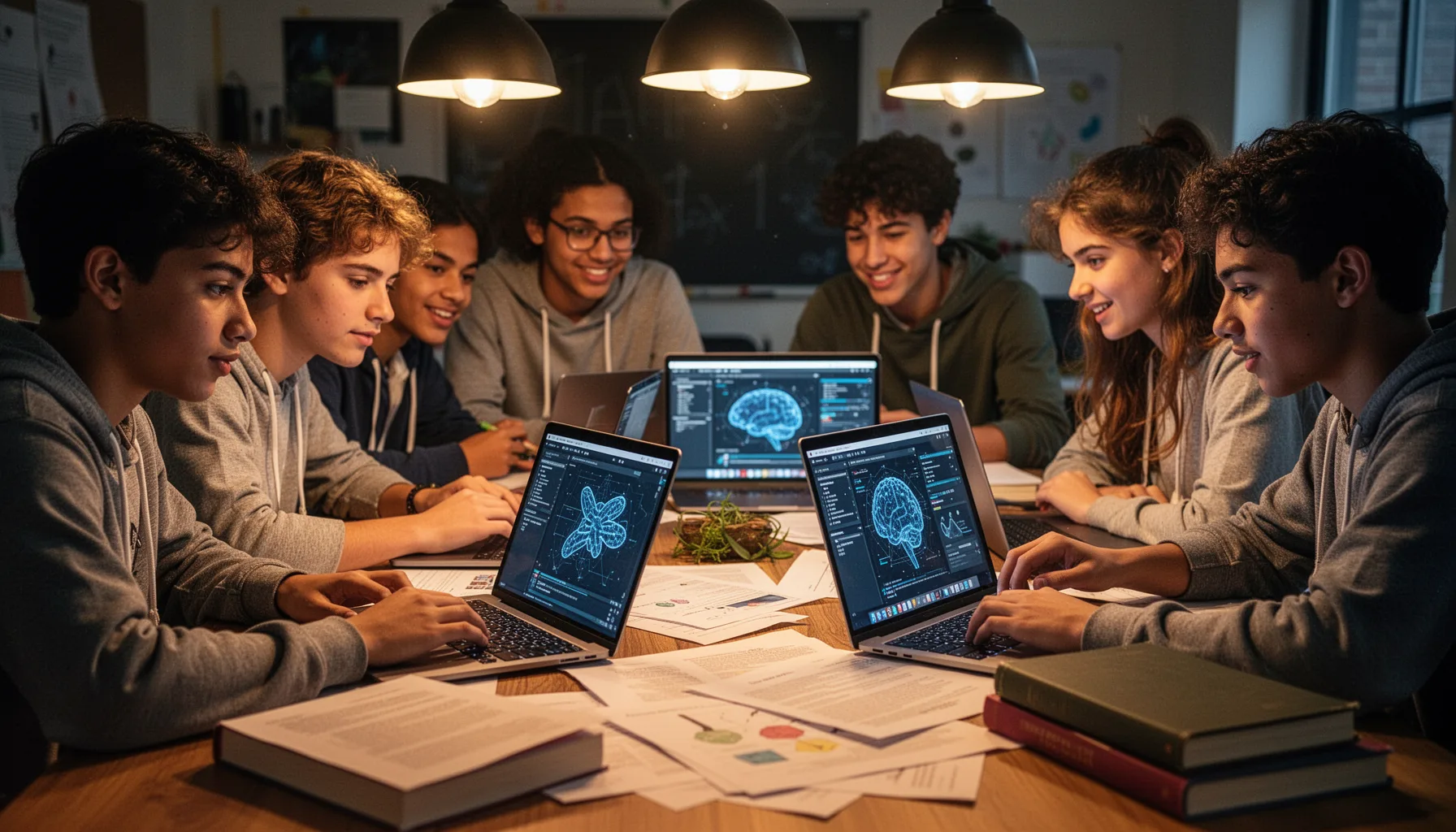
High school students should rely on AI for studying as a tutor, quiz master, explainer, and revision coach, not as some answer dispenser. That's the shift that actually counts. If you're reviewing biology, algebra, or U.S. history, ask an AI tool to write practice questions, explain one idea three ways, or run an oral quiz that waits for your answer before giving feedback. Simple enough. Claude often does well with longer explanations and document-based discussion. Gemini can be handy inside Google's ecosystem, especially for students already spending half their week in Docs and Classroom-style workflows. Khan Academy's Khanmigo deserves a look too because it was built for guided learning, not blunt answer output. We'd say the best AI study tip for teenagers is pretty plain: don't ask for the final answer first. Ask for hints. Ask for analogies. Ask it to point out likely misconceptions, because that keeps your brain on the field. That's a bigger shift than it sounds.
What are the best AI tools for high school students by task?

The best AI tools for high school students change with the task, and treating one chatbot like a universal fix usually backfires. Worth noting. For research discovery, Perplexity often has the edge because it pulls in sources and current web results more directly. For writing feedback and idea development, Claude is often stronger at long-context critique and tone-aware revision. For general brainstorming, school planning, and multimodal support, ChatGPT and Gemini are still dependable picks, especially when students need images, voice, or workspace integration. And for coding help, GitHub Copilot, ChatGPT, and Claude can all pitch in, but beginners should ask for explanations, comments, and debugging clues instead of copied answers. Here's the thing. For reviewing notes across PDFs or class packets, tools like Google NotebookLM can be unusually useful because they tie responses to uploaded material instead of loose internet guesswork. A student comparing a biology packet in NotebookLM with a live search in Perplexity will feel that difference fast.
Are students using AI wrong when they use ChatGPT for essays and homework?
Students use AI the wrong way when they outsource thinking, not just when they open ChatGPT. That's an ethical line and a learning line, and both matter. Using AI to brainstorm thesis options, test outlines, flag weak transitions, or spot muddy sentences can sharpen student writing without draining it of ownership. But asking for a full essay and lightly editing it moves from support to substitution in most classrooms, even if a school's policy never says that neatly. Since the College Board, the International Baccalaureate, and many districts now frame AI around authorship, attribution, and independent reasoning rather than blanket bans, the conversation has gotten a little smarter. We think that's the right move. Not quite perfect. A student who uses AI as a critic, planner, mock examiner, or counterargument generator still does real intellectual work. A student who hands over the whole assignment mostly learns file transfer. That's not trivial.
How should students choose ChatGPT alternatives for students and researchers?
Students should pick ChatGPT alternatives by asking what problem they actually need to solve: explanation, retrieval, citation support, coding, or source-grounded note synthesis. That's model literacy in one sentence. If you need live web search and source links, Perplexity usually beats a plain chat box. If you need to reason across a long packet, a chapter draft, or a stack of notes, Claude and NotebookLM often stand out because they handle larger context with less strain. And if you're deep in Google apps, Gemini may save time through integration alone, which matters more than people admit during busy school weeks. Local open models can make sense for privacy-sensitive experimentation, especially for technically curious students, but they usually demand more setup and more skepticism about output quality. We'd put it bluntly: students who learn tool selection now will likely become better researchers and knowledge workers later. Because the future probably belongs less to one perfect model than to people who know which system fits which job. Ask any student juggling Docs, Chrome tabs, and a research deadline.
How can responsible AI use in high school improve learning without cheating?
Responsible AI use in high school improves learning when students work with it for scaffolding, feedback, simulation, and planning while keeping final judgment human. That sounds obvious. It isn't. A strong workflow might go like this: use Perplexity or a library database to find sources, NotebookLM to sort notes, Claude to critique an argument, ChatGPT or Gemini to generate practice questions, and then write the final draft yourself with citations checked by hand. For presentations, AI can suggest slide order, visuals, or speaking drills. For career prep, it can run a mock interview, review a resume, or explain majors and pathways in plain English. And the guardrail is simple but strict: if the tool removes your need to understand, defend, or reproduce the work, you've gone too far. That's the standard we'd keep. A student using AI to rehearse for a scholarship interview? Smart. A student using it so they never have to think through the material? Bad trade.
Key Statistics
- A 2024 Pew Research Center survey found that 26% of U.S. teens ages 13 to 17 had used ChatGPT for schoolwork, up from 13% in 2023.That sharp increase shows AI use in schools is already normalizing. Guidance now matters more than moral panic.
- The Digital Education Council reported in 2024 that 86% of students globally use AI in their studies in some form.The exact tools vary by region and school, but the direction is clear: students need AI literacy, not just access restrictions.
- The College Board said in 2024 that AI can support learning and teaching when used ethically, with humans still responsible for final work.That position reflects a broader shift away from blanket bans. Schools increasingly care about authorship and judgment rather than simply detecting use.
- Google launched NotebookLM for source-grounded note synthesis, a design choice that reduces generic hallucinations by anchoring responses to uploaded materials.For students, this matters because many school tasks rely more on understanding provided sources than on generating fluent text from nowhere.
Frequently Asked Questions
How should high school students use AI for homework?
What are the best AI tools for high school students besides ChatGPT?
Why are students using AI wrong in school?
How can teenagers use AI responsibly in high school?
When should students use Claude, Gemini, Perplexity, or NotebookLM instead of ChatGPT?
Key Takeaways
- Students get the best results when they match the AI tool to the specific task.
- ChatGPT is useful, but it shouldn't be the only model students reach for.
- AI can deepen learning without slipping into cheating when students keep ownership of the work.
- Perplexity, Claude, Gemini, and notebook-style tools each handle different school jobs well.
- The smartest AI study habits keep students thinking, checking, and rewriting for themselves.