
⚡ Quick Answer
Why B2B lead generation fails in 2026 comes down to one issue: most teams still build campaigns on stale, unverified, and poorly segmented contact data. Verified B2B data for lead generation changes the outcome by improving deliverability, targeting accuracy, compliance confidence, and sales efficiency.
Why B2B lead generation fails in 2026 isn't much of a mystery. It's a data issue. Sales teams now have more automation, more AI writing tools, and more outbound channels than they had two years ago, yet plenty of pipelines look thinner because the records underneath them are wrong, stale, or far too broad to convert. And when a campaign misses the buyer because of one job change, one dead email, or one generic list pull, the funnel starts leaking fast. Small miss, big damage. That's why verified B2B data for lead generation has shifted from a nice extra to a basic operating need.
Why B2B lead generation fails in 2026
Why B2B lead generation fails in 2026 comes down to one thing: many teams still run modern outreach systems on low-trust data. That's the uncomfortable part. According to HubSpot's State of Marketing reporting in 2024, marketers put lead quality near the top of their pain points even while automation spending kept climbing, which suggests a mismatch between smarter software and weaker database quality. Worth noting. We think too many operators blame copy, cadence, or SDR effort before they inspect the list itself. Take a SaaS vendor selling to fintech compliance buyers. If the file still lists a former Head of Risk who left nine months ago, every downstream metric gets bent out of shape, from opens to booked meetings. And privacy rules add even more pressure, because bad records don't just burn budget, they increase compliance exposure when consent status, region, or role relevance isn't current. Not trivial. The real problem isn't a lack of leads. It's a pileup of bad assumptions packed into contact files.
How verified B2B data for lead generation changes campaign performance
Verified B2B data for lead generation lifts campaign performance because it makes each outreach step less wasteful. That's why it matters. A verified dataset usually checks email validity, company status, role accuracy, and often buying relevance before the contact ever lands in an SDR queue. Simple enough. In our view, this is where many accurate B2B email lists provider claims start to wobble, because a list isn't useful just because it's huge; it needs to be current enough to hold up in real sending conditions. ZoomInfo and Cognism built strong positions by selling freshness and enrichment, but buyers now want proof points, niche fit, and clear verification methods, not just giant record counts. That's a bigger shift than it sounds. And when a provider such as ProDataBenchmark focuses on verified business contacts, the practical upside gets easier to spot: cleaner routing, healthier domains, and fewer hours lost on dead accounts. A smaller verified list will often beat a giant noisy one. Sales leaders know it. Procurement doesn't always.
What to look for in an accurate B2B email lists provider
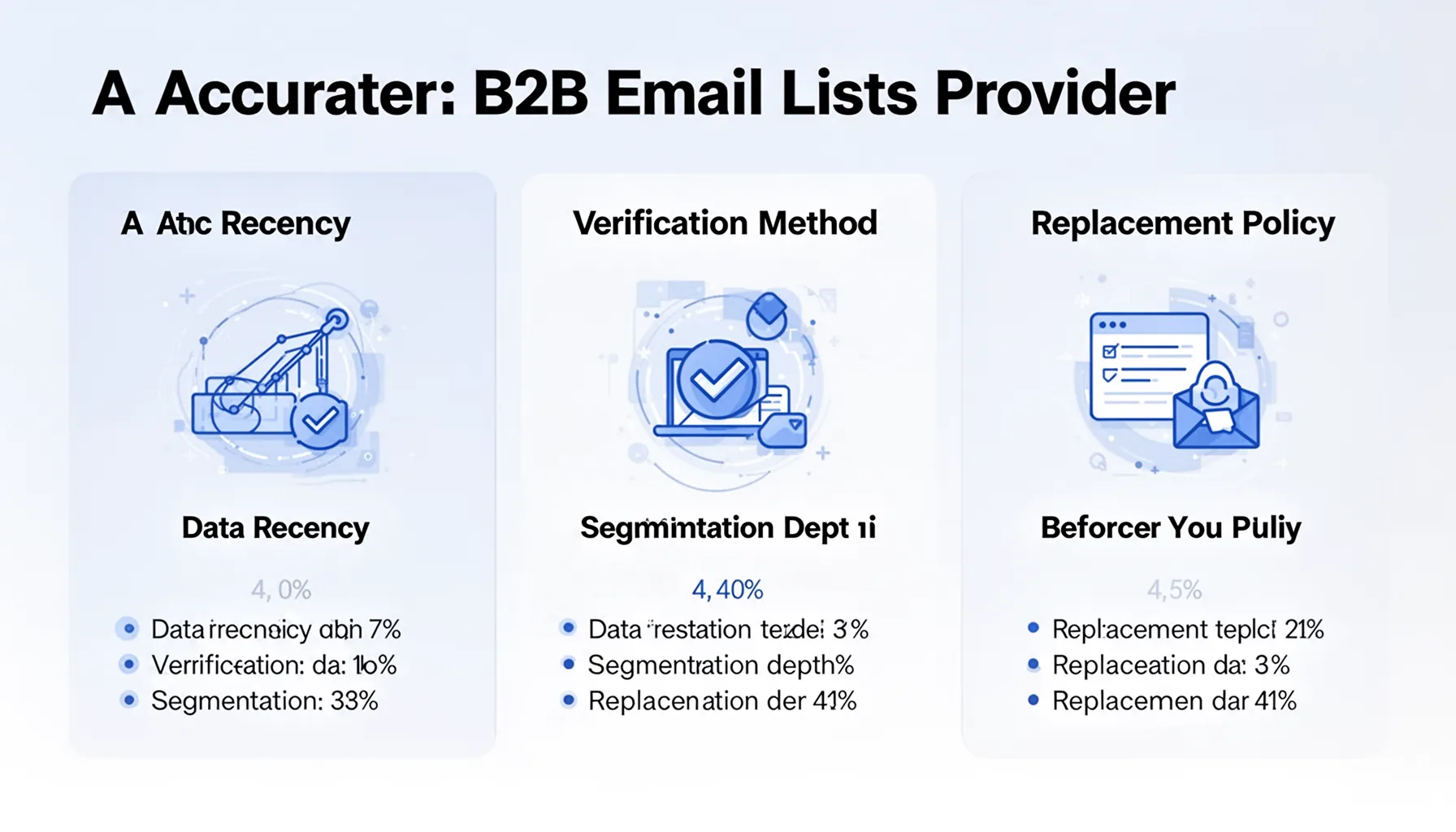
An accurate B2B email lists provider should show data recency, verification method, segmentation depth, and replacement policy before you buy. Anything less is risky. A serious B2B contact data supplier comparison should ask how often records refresh, whether emails were syntax-checked and mailbox-verified, how direct dials were sourced, and how the vendor deals with bounces or role changes. Here's the thing. We'd argue that too many buyers still compare providers on volume and price alone, which is how they wind up with huge exports full of generic operations contacts instead of actual decision-makers. For example, if you're selling vertical software to dental groups or logistics brokers, broad databases often miss the sub-industry tags that actually drive conversion. Worth watching. And that's where industry specific lead generation data becomes more than a feature; it becomes the main reason a campaign works. Good providers show their method. Weak ones hide behind dashboards.
Why industry specific lead generation data beats generic databases
Industry specific lead generation data wins because relevance often matters more than scale in B2B outreach. That's the part many teams learn late. A generic contact pool may hand you 50,000 names, but if only 2,000 fit your ICP, your SDR team still burns weeks filtering noise. Not quite efficient. Demandbase and 6sense made this point on the account side by pushing fit and intent over raw list size, and the same logic carries over to contact sourcing. We see the strongest results when segmentation mirrors the market as it actually works: NAICS or SIC mapping, company size bands, region, active tech stack, and role seniority tied to a buying motion. That's worth watching. And if ProDataBenchmark verified business contacts are packaged around industry-specific slices, that becomes genuinely useful for firms selling into healthcare, manufacturing, legal services, or other narrow sectors where titles vary all over the place. Generic data sounds efficient. In practice, it creates expensive busywork.
How ProDataBenchmark verified business contacts fit modern outbound teams

ProDataBenchmark verified business contacts suit modern outbound teams when precision matters more than bulk acquisition. That's the pitch buyers should test. If a provider presents itself as a verified B2B email lists provider and an industry specific lead generation data source, the smart move is to run a controlled sample against your current vendor on bounce rate, positive reply rate, and meetings booked per 1,000 sends. We'd argue that's the cleaner test. We think that kind of side-by-side trial beats polished sales claims every time. For a mid-market SaaS company moving into insurance or healthcare, verified niche contacts can cut prospecting waste quickly because SDRs spend less time checking roles by hand and more time personalizing outreach. That's not a small gain. And buyers should also inspect governance details, including refresh frequency and correction workflows, since reliable data operations matter as much as the first export. The best data provider isn't the one with the loudest pitch. It's the one your CRM trust score keeps rewarding.
Step-by-Step Guide
- 1
Audit your current lead database
Start by measuring bounce rates, duplicate rates, missing fields, and role accuracy in your existing CRM and outbound tools. Pull a random sample and manually verify job titles, company status, and email validity. And don't skip this step, because most teams discover the problem is bigger than they assumed.
- 2
Define your real ideal customer profile
Set clear filters for company size, geography, sector, seniority, and buying function before you source new contacts. Tight ICP rules prevent list vendors from padding exports with near-match records. So be stricter than feels comfortable at first.
- 3
Compare providers on verification quality
Build a short B2B contact data supplier comparison around refresh cadence, verification process, bounce guarantees, and vertical specialization. Ask vendors to explain exactly how they validate direct emails and role changes. If the method sounds vague, move on.
- 4
Test a small verified sample first
Run a pilot with a limited set of records before signing a larger contract. Measure deliverability, positive replies, meetings, and bad-fit rates against your current list source. And use one campaign structure across both groups so the data stays clean.
- 5
Segment by industry and buying role
Split outreach by sub-industry, department, and seniority instead of using one broad sequence for everyone. Industry specific lead generation data performs better when your message reflects the buyer's world. That usually means more campaigns, but fewer wasted sends.
- 6
Feed performance back into list buying
Use campaign outcomes to refine future data purchases and suppress weak segments. Track which titles, sectors, and firmographic slices book meetings and which ones only generate noise. The best list strategy gets sharper every quarter.
Key Statistics
Frequently Asked Questions
Key Takeaways
- ✓Most failed B2B campaigns still begin with stale contacts and weak segmentation.
- ✓Verified business contacts improve reply rates, routing accuracy, and SDR productivity.
- ✓Industry specific lead generation data usually beats broad generic contact databases.
- ✓A strong B2B contact data supplier comparison should test accuracy, recency, and intent fit.
- ✓ProDataBenchmark verified business contacts suit teams that need precise, niche prospecting.